Last week, Robert Camarillo had an urgent message for Oregon lawmakers: His union members are fleeing the state because there’s no work.
“We’re losing a lot of our members to projects out of state—to Idaho, Nevada, California,” Camarillo, executive secretary of the Oregon Building Trades Unions, told the House Interim Committee on Economic Development, Small Business, and Trade last week. “It’s a crisis.”
Camarillo’s concerns carry a lot of political weight because his more than 50,000 trade union members and their campaign contributions have played a key role in building Democratic control of the state.
The math behind the crisis Camarillo highlighted is stark. Oregon’s overall unemployment rate is tied for second highest in the nation at 5.2%. Among Camarillo’s trade union members—electricians, carpenters, boilermakers and others—unemployment runs in the double digits, with some union locals topping 20%, nearly five times the national rate.
The timing is awkward for Gov. Tina Kotek. International Brotherhood of Electrical Workers Local 48, part of the Oregon Building Trades Unions, contributed a record $400,000 to her reelection campaign in late June. Two months later, facing voter backlash from data centers’ environmental, noise and cost impacts, both Kotek and her Republican opponent, Christine Drazan, called for a statewide moratorium on new projects—reversing their prior positions.
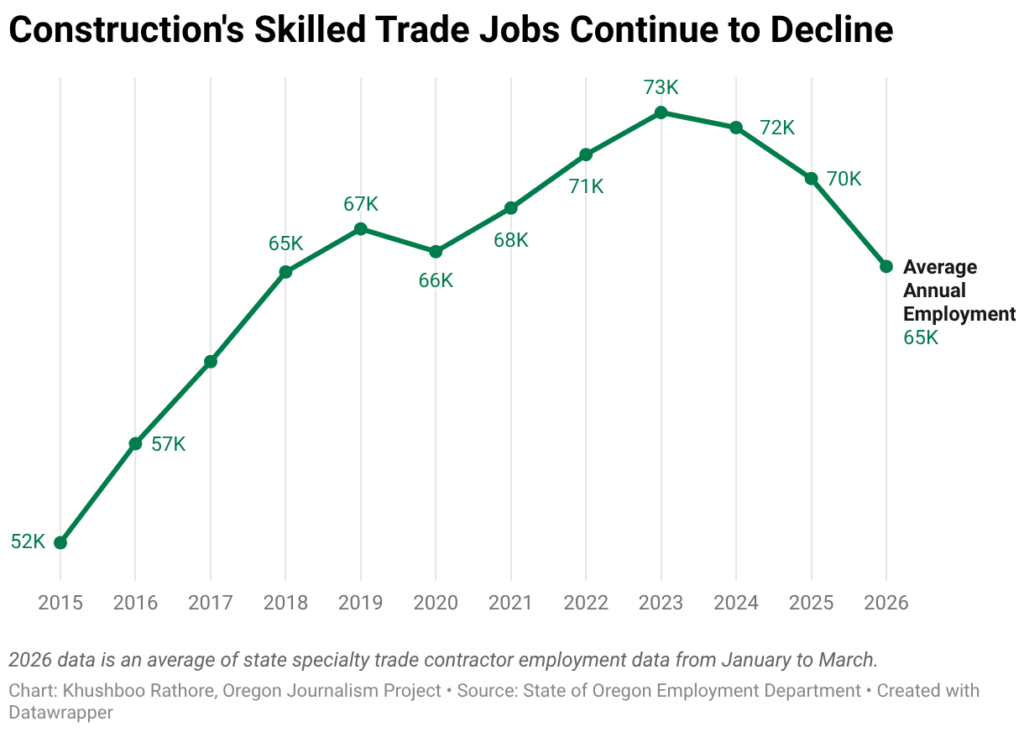
Employment for specialty tradespeople such as electricians, carpenters and boilermakers has been declining in Oregon since 2023. Preliminary state data for the first quarter of 2026, the latest available, shows an average employment of about 65,000 in the field, down 3,000 or about 5% from the same time last year.
While new construction in the state has slowed, the particular sore point is the intensifying controversy over halting data center growth in Oregon. According to an IBEW report, wages and overtime for electricians can account for 45% to 70% of a new data center’s construction costs.
Most Oregon voters oppose new data centers in the state, an August DHM Research survey shows. And nearly 75% of voters don’t want data centers to get special tax breaks, which had fueled their growth in Oregon over the past decade.

Meanwhile, regional trade unions such as IBEW Local 48 have pushed for more data centers to bring trades jobs and keep them in Oregon.
The lack of jobs for skilled tradespeople is also blocking the trade apprenticeship pipeline, Camarillo said. Many companies have paused hiring, which means fewer opportunities exist for registered apprentices to get the on-the-job experience needed to qualify for a journeyman card.
“It’s hard to train workers and have them ready if we don’t have any jobs tee’d up,” Camarillo told lawmakers.
Meanwhile, skilled trade workers will likely continue to seek work in Idaho and elsewhere.
This story was produced by the Oregon Journalism Project, a nonprofit investigative newsroom for the state of Oregon. The Prineville Review became a partner of OJP in August of 2025 in order to bring our readers investigative reporting from across Oregon.

Khushboo Rathore
Khushboo Rathore is a data and engagement reporter for the Oregon Journalism Project. She has journalism and information science degrees from the University of Maryland, College Park. She was most recently the Roy W. Howard Fellow at Wisconsin Watch.