Alfalfa, Ore. — Records obtained by the Prineville Review from the Oregon Department of Forestry (ODF) reveal that a private wildfire contractor employing former Alfalfa Fire District Chief Chad LaVallee listed the district’s publicly owned fire station as its dispatch location and included one of the district’s fire engines in a state wildfire contracting agreement.
The agreement, entered into on June 1st, 2026, between ODF and Cedar Creek Tactical Water LLC, came just weeks before LaVallee’s planned departure from his paid position as the district’s chief on July 1st.
In an interview with the Prineville Review, the company’s owner, Ryan Harris, confirmed that LaVallee worked for the company as a paid employee during the summer and an unfulfilled arrangement to contract out the district’s Type 4 fire engine through Harris’ company.
While Harris said that the proposed arrangement never materialized beyond the vehicle being listed on the state contract, he also disclosed that LaVallee had provided a firefighting skid unit that was installed on one of the company’s privately owned trucks and used during wildfire assignments in Oregon.
That disclosure comes amid continued questions surrounding the whereabouts of a skid unit that was removed from the district’s own Type 6 brush truck sometime during the summer. Multiple sources familiar with the district’s equipment have alleged that the skid was used by LaVallee in his private wildfire contracting activities.
ODF confirmed to the Prineville Review that Cedar Creek Tactical Water received $145,450 for wildfire assignments during the summer, including $79,650 for deployments of the Type 6 engine on which Harris said the skid provided by LaVallee had been installed.
The district’s newly appointed volunteer fire chief, David Wolting, confirmed Tuesday that he was already looking into reports of potentially missing district equipment, including the skid, and is calling for former employees and volunteers to immediately return any district property still in their possession.
Private company registered using Alfalfa fire station address
The ODF Incident Resource Agreement, No. 0514ODF26CED, was signed June 1st, 2026, by Harris and ODF contract officer Misty Easter.

While the agreement identifies the company’s mailing address in Ridgefield, Washington, its dispatch address is listed as 25889 Alfalfa Market Road, the address of the Alfalfa Fire District’s fire station.
Three firefighting resources were listed as active under the agreement beginning June 1st:
- Type 2 water tender — $2,350 per day.
- Type 4 fire engine — $3,600 per day.
- Type 6 fire engine — $2,700 per day.
The agreement, which is scheduled to remain in effect through December 31st, 2029, provides for combined daily rates of $8,650 should all three vehicles be deployed.
It was also discovered that Cedar Creek Tactical Water, a Washington-based limited liability company, registered to conduct business in Oregon on May 15th, 2026, using the fire station’s address for its Oregon registered agent, which it identified as Harris.
Harris, however, told the Prineville Review that he had never been to the Alfalfa fire station and that the decision to use the address came from discussions with LaVallee, who was still the district’s chief at the time.
“[LaVallee] said that I could use that as a dispatch location because the rigs were going to be there,” Harris said.
Harris attributed the use of the fire station as his registered agent address to a misunderstanding of Oregon’s business registration requirements, noting that this was his first year operating the company.
He said he has since updated the dispatch information with ODF to reflect his company’s location in Washington and intends to make corrections to his Oregon business registration.
In response to questions from the Prineville Review, ODF Public Affairs Officer Jessica Neujahr confirmed Tuesday that the agency was not made aware that the dispatch address listed on the company’s contract belonged to a public fire district until September.
When asked whether ODF had verified that the company was authorized to use the public facility, Neujahr said that was not something the agency verifies as part of its Incident Resource Agreements.
LaVallee made verbal agreement with company to store and use water tender
Harris said his company’s use of the station address stemmed from an earlier arrangement he had made with LaVallee involving a privately owned water tender.
According to Harris, the district’s own water tender was out of service, and he offered to allow the district to use his tender in exchange for storing the vehicle inside the fire station and keeping it on a battery charger.
The arrangement was made before the company entered into its contract with ODF.
Harris said he understood that the district had used his tender on a couple of structural fire responses.
When asked whether he had ever entered into a written agreement with the fire district regarding the vehicle’s storage or use, Harris said he had not.
“It was just a verbal agreement with [LaVallee] as the chief,” Harris said.
Harris said he subsequently had the tender removed from the station after learning that LaVallee would no longer be serving as chief, as he did not know anyone else at the district.
Harris could not recall the exact date the tender was removed from the district.
District-owned fire engine listed on private company’s state contract
Of the three firefighting resources listed on the company’s agreement with ODF, one of the vehicles did not belong to Cedar Creek Tactical Water.
Harris confirmed that the Type 4 fire engine identified on the contract belonged to the Alfalfa Fire District.
The vehicle was listed on the company’s state contract at a daily rate of $3,600.
Harris said it was LaVallee who had wanted the vehicle added to the company’s contract with ODF, explaining that LaVallee wanted an agreement to use the district vehicle, including providing compensation to the district.
“That was something that [LaVallee] was wanting to add on there for Alfalfa,” Harris said.
The vehicle was included on the contract, which Harris attributed to ODF’s requirement that vehicles be listed before they could be dispatched.
Harris maintained that the district’s engine was never deployed and said he had since requested that ODF remove it from his contract.
That claim was corroborated Tuesday by ODF.
Harris also told the Prineville Review that at no point had he spoken with any members of the district’s board of directors regarding the arrangement. Those discussions were with LaVallee.
There were no apparent meeting records of LaVallee ever disclosing those discussions to the board or seeking its approval before the vehicle was included in the private company’s state contract.
ODF paid private company more than $145,000 for wildfire assignments
On Tuesday, ODF provided the Prineville Review with a breakdown of payments totaling $145,450 made to Cedar Creek Tactical Water for wildfire assignments between July 16th and August 27th.
The company’s first assignment came just over two weeks after LaVallee’s departure from his paid position as the district’s chief, with its Type 6 engine deployed to the Lower Dry Creek Mutual Aid incident, followed by deployments to the Bradley Flats and Brewer incidents later in July. The company received a combined $28,350 for those three assignments.
The company was subsequently paid $51,300 for the deployment of its Type 6 engine to the Rowe Creek Complex between July 28th and August 19th, bringing the total paid for assignments involving that vehicle to $79,650.
It was that vehicle on which Harris said a firefighting skid provided by LaVallee had been installed.
The remaining $65,800 was paid to the company for the deployment of Harris’ own Type 2 water tender to the Rowe Creek Complex between July 28th and August 27th. That vehicle did not utilize the equipment provided by LaVallee, according to Harris.
No payments were made for deployments of the district-owned Type 4 engine listed on the company’s contract.
ODF also confirmed that it was unaware of LaVallee’s involvement with Cedar Creek Tactical Water while he was still serving as the district’s paid chief.
Neujahr said the agency was made aware of LaVallee’s departure from the district in September, as well as the existence of some ethics complaints involving him, but had not been made aware of the details of those complaints.
When asked whether the agency had received or reviewed any concerns regarding the company’s use of district facilities or potentially district-owned firefighting equipment, Neujahr said it had not.
Questions remain over whereabouts of district’s firefighting skid
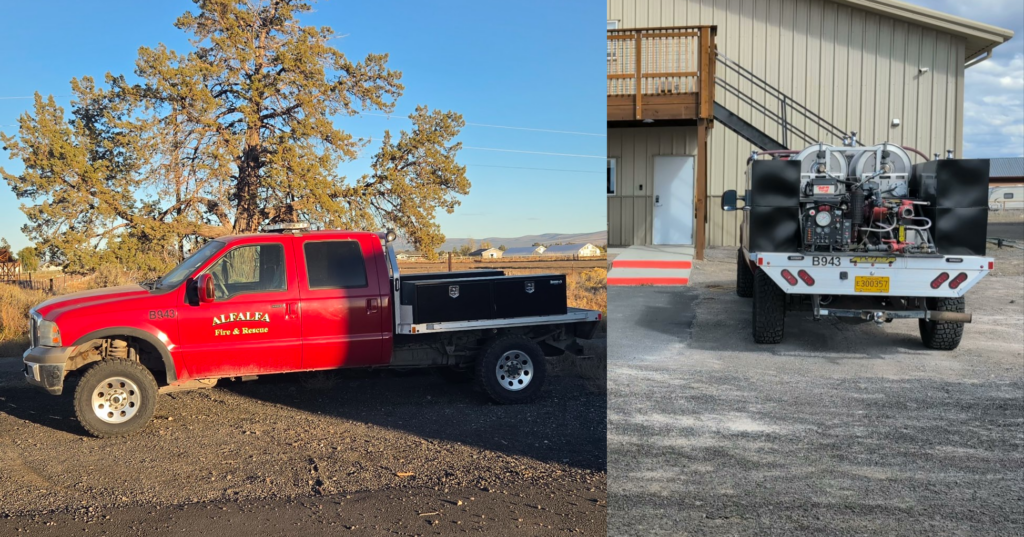
For several months, questions have been raised about equipment that was previously installed on the Alfalfa Fire District’s Type 6 brush truck, which now sits behind the district’s fire station.
Former board member Mark Laucks, who had pushed for the sale of the vehicle, previously claimed at a public meeting that the skid equipment had been destroyed.
Questions were also raised about Laucks’ account of how the equipment was originally acquired by the district, with subsequently identified records indicating that the skid was purchased for $4,000 from another fire agency.
The rest of the board ultimately declined to move forward with Lauck’s quick sale of the vehicle, opting instead to leave the review of district apparatus and equipment to its incoming fire chief.
Photographs and videos taken by the Prineville Review at the fire station in April were subsequently reviewed by sources familiar with the district’s apparatus, who identified the skid unit as being installed on the vehicle at that time.
Several sources have since alleged that the skid was removed from the district’s vehicle and used by LaVallee during his private wildfire contracting activities over the summer.
Recent photographs show the missing equipment from the same vehicle, identified as B943.
“[LaVallee] provided a skid unit. I don’t know where he obtained that from, but Chad provided a skid unit that we used on a couple of fires,” Harris said.
Harris explained that he had a flatbed truck that he intended to outfit as a Type 6 fire engine and that LaVallee had told him he had a skid unit.
Harris said it was his understanding that the equipment belonged to LaVallee personally.
According to Harris, when the company’s truck was returned to Harris in Washington following its wildfire contracting work in Oregon, however, the skid was no longer on the vehicle.
“I don’t know who took it off because I just know when my truck came back to me, the unit wasn’t on there,” Harris said.
Harris said he does not know where the equipment is now and that it is no longer in his company’s possession. He also offered to provide photographs of the truck sitting empty at his warehouse.
When asked how he would respond if he were to subsequently learn that the equipment belonged to the Alfalfa Fire District, Harris said he would want additional information.
New fire chief calls for immediate return of district property
In speaking with the Prineville Review Wednesday, newly appointed Alfalfa Fire District Chief David Wolting said he had already been made aware of concerns regarding potentially missing district equipment before being provided with additional information obtained during our investigation.
Wolting, who has been on the job for less than a week, confirmed that he had personally inspected the Type 6 truck that remains behind the fire station.
“I can confirm that I viewed that vehicle and it does not have any skid unit in the back of it,” Wolting said.
Wolting said one of his top priorities will be conducting a complete inventory of the district’s assets, noting that he has also been told that district equipment is stored at various locations throughout the fire district, including with both current and even former volunteers.
He said he wants to personally account for that equipment and would welcome assistance from members of the public in cataloging the district’s property.
Wolting also made clear that his concerns are not limited to the missing skid.
“All district equipment from former employees, former volunteers that are no longer associated with the fire district needs to immediately be returned to the fire district,” Wolting said.
He said he believes some district property is likely still in the possession of former employees and possibly former volunteers, including radios, pagers, firefighting turnouts and other equipment and clothing identifying the Alfalfa Fire District.
“I am going on the record at this point to say that it is imperative that that equipment and inventory be returned to the fire district,” Wolting said.
Given the potential value of some of the equipment and the district’s ongoing financial struggles, the Prineville Review asked Wolting about taxpayers who are calling for the district to seek the assistance of law enforcement in recovering its property.
“I feel as though there’s some due diligence that still needs to be done before we can take this a step further,” Wolting said. “I would like to provide the opportunity for the equipment to be brought back to its rightful ownership of the district.”
Wolting said he was still gathering information and would need to have further discussions with the board of directors before making any recommendations on how the district should proceed.
He stressed that he did not want to make accusations without first thoroughly vetting the information.
Wolting also acknowledged some of the frustrations expressed by members of the public regarding the district, asking that they exercise some patience with the new administration as its volunteers and board members work to determine where records and equipment are located.
“We want transparency. We all of us want transparency at this particular time,” Wolting said.
He committed to following up with the Prineville Review regarding what he is or is not able to find, adding that the district’s equipment ultimately belongs to the taxpayers.
“It’s their equipment, and I feel as though the fire district is the custodian of it, and we need to manage the assets well, or we won’t have assets,” Wolting said.
Arrangements with private company came ahead of LaVallee’s planned departure
While several sources had previously described LaVallee as having partnered with Harris in the private wildfire contracting business, Harris told the Prineville Review that LaVallee was instead hired as a seasonal employee.
“I hired Chad. I didn’t partner with Chad,” Harris said.
Harris said LaVallee was paid hourly as an engine boss and was a W-2 employee of the company, rather than receiving a percentage of its contracting revenue.
Harris also indicated that LaVallee brought another individual associated with the Alfalfa Fire District to work for the company. Harris said he had never personally met that individual.
While LaVallee’s paid employment with the district ended July 1st, he continued in what was subsequently described as an unpaid role as training director, although statements made in the months that followed by both LaVallee and Laucks were at times inconsistent regarding his actual role with the district.
Harris said LaVallee is no longer employed by his company, noting that the employment was seasonal and that he had not been fired.
Of particular concern, however, is that the arrangements with Harris involving district resources were made during the final weeks of LaVallee’s tenure as the district’s paid chief, ahead of his planned departure and subsequent paid wildfire work with the company.
Under Oregon Government Ethics Law (ORS 244.040), public officials are prohibited from using or attempting to use their public positions to obtain financial benefits for themselves or a business with which they are associated that would not otherwise be available but for their positions, subject to certain exceptions.
Under ORS 244.020, that includes businesses by which a public official is employed, regardless of whether the official has an ownership interest in the business.
Guidance published by the Oregon Government Ethics Commission (OGEC) also specifically addresses the use of public facilities, equipment and other government resources in connection with a public official’s outside employment.
While the district’s Type 4 engine was never deployed, Oregon Government Ethics Law also prohibits attempts to obtain an improper financial benefit through one’s public position.
LaVallee is already the subject of multiple state investigations, including an investigation by the Oregon Government Ethics Commission (OGEC), which voted unanimously on May 8th to proceed with a formal investigation into four potential violations of Oregon Government Ethics Law.
The commission’s preliminary review found a “substantial objective basis” to believe LaVallee may have violated state laws governing nepotism, conflicts of interest and the use of public office for financial gain, primarily involving the hiring and supervision of his wife, Leslie LaVallee, whose paid position with the district was funded through grants from the Oregon State Fire Marshal’s Office (OSFM).
Alfalfa Fire District Budget Committee member Sarah Linden has also recently filed new ethics complaints against both LaVallee and former elected board president Nathan “Nate” Starr.
As we previously reported on November 7th, Linden’s complaint against Starr followed a review of district banking records that showed no identifiable payments for years of private church services held at the fire station, despite Starr’s previous public assertions that he had paid the district’s required facility usage fees.
The Oregon Secretary of State also has another ongoing investigation into reported election law violations. Crook and Deschutes County Clerks Cheryl Seely and Steve Dennison, respectively, made those reports after concerns were raised by local electors.
Several days after our April 24th story confirming the State election law investigation, the district’s attorney, Jered Reid, issued a formal notice of trespass against this reporter and the Prineville Review, which a federal judge later blocked.
Continuing scrutiny of district finances and equipment
The latest findings come amid ongoing investigative reporting by the Prineville Review and KTVZ NewsChannel 21 into the management of the Alfalfa Fire District under LaVallee and several of its former board members.
Earlier this month, the Prineville Review reported on district credit card statements obtained following extensive efforts to secure the records, which revealed numerous expenditures for travel, hotels, restaurants and other purchases, including expenses involving members of LaVallee’s family.
The district’s financial management, including issues surrounding state and federally funded firefighting equipment, has also been the subject of continued scrutiny.
Last week, the district’s board suspended LaVallee and restricted his access to district facilities amid concerns over financial irregularities.
Harris said that while he considers LaVallee a friend, he has sought to remain separate from the ongoing controversies surrounding him and the district.
Harris maintained that he had operated under the understanding that the arrangements made with LaVallee, who was the district’s chief at the time, were permissible.
“From my understanding it was all by the books so you know, if it wasn’t that wasn’t my doing,” Harris said.
Harris also offered to provide additional documentation concerning his company’s wildfire assignments and payments.
The Prineville Review has submitted additional public records requests to ODF seeking documentation of those assignments, as well as records concerning the equipment used by the company and communications surrounding its state contract.
Among the questions that remain unanswered is what happened to the district’s firefighting skid, which Laucks previously claimed had been destroyed, and where LaVallee obtained the skid he provided for use on a privately owned fire engine that went on to generate nearly $80,000 in state payments during the summer.

Mr. Alderman is an investigative journalist specializing in government transparency, non-profit accountability, consumer protection, and is a subject matter expert on Oregon’s public records and meetings laws. As a former U.S. Army Military Police Officer, he brings a disciplined investigative approach to his reporting that has frequently exposed ethics violations, financial mismanagement, and transparency failures by public officials and agencies.