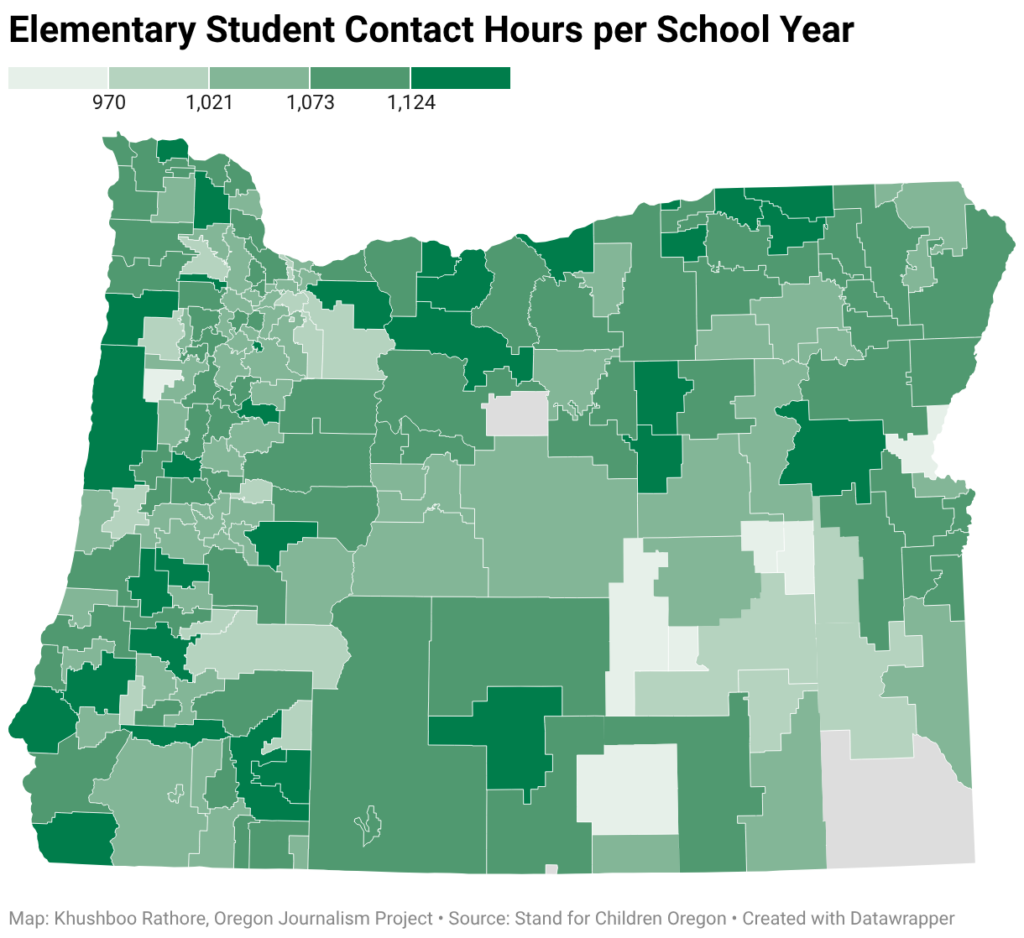
For years, the state of Oregon has ranked near the bottom when it comes to instructional time for kids in school. It currently ranks 47 out of 50 states.
Even so, a precise picture of the gaps in school days among the state’s 197 school districts has been murky—until now. A new report by the education reform group Stand for Children Oregon and research group ECOnorthwest shows as much as an eight-week difference in the length of the academic year among elementary students, depending on where they go to school in Oregon.
The data, collected by Stand for Children Oregon and analyzed by ECOnorthwest, highlights one of the downsides of local control that is a hallmark of the state’s educational system. “Oregon has set a very low floor for time in school, and allows broad flexibility in how districts meet it,” says Stand for Children Oregon executive director Sarah Pope.
Stand for Children also released an online lookup tool that provides details about each district’s school year. One of the high-level findings: Many districts already work on a calendar of four days a week.
Elementary schoolers in Jackson County’s Butte Falls School District, which has a four-day schedule, get the most schooling per year—1,176 hours. Near the low end is Harney County School District, which provides just 989 hours, or about 137 school days of 7.25 hours.
But even the Oregon elementary school with the longest school year is below the national average of 180 days, or 1,231 “contact hours,” according to the report. In Oregon, the average elementary schooler has 165 contact days, or 1,116 hours—9% less than the national average.
Earlier this month, Gov. Tina Kotek issued an executive order forbidding school districts from cutting school days to balance declining budgets.
More than 80 of the state’s school districts, which enroll about 10% of Oregon’s 545,000 students, operate on a four-day schedule. On average, students on a four-day schedule receive 12.9 fewer hours of education per year, OJP’s analysis shows.

State Rep. April Dobson (D-Happy Valley) says she and her colleagues intend to introduce a bill that would set a floor for the state’s school year at 180 days, the same as Washington state’s. “It’s not sustainable to continue the way we are going,” Dobson says.
Studies have shown that extended learning time can lead to improved academic outcomes, especially when bundled with reforms to enhance instructional quality.
This story was produced by the Oregon Journalism Project, a nonprofit investigative newsroom for the state of Oregon. The Prineville Review became a partner of OJP in August of 2025 in order to bring our readers investigative reporting from across Oregon.

Khushboo Rathore
Khushboo Rathore is a data and engagement reporter for the Oregon Journalism Project. She has journalism and information science degrees from the University of Maryland, College Park. She was most recently the Roy W. Howard Fellow at Wisconsin Watch.