Prineville, Ore. — Months after Oregon lawmakers approved $1 million for horse-racing facilities in Crook County, county officials still have not accepted the money and are now considering whether to ask the Legislature to change how the grant is awarded.
The issue came before the Crook County Board of Commissioners on Sept. 2nd for an extensive discussion over restrictions attached to the grant, potential costs to taxpayers and whether the money could instead be placed directly under the control of the Crooked River Roundup.
The discussion also renewed questions surrounding a previously undisclosed Fair Board “Funding Committee” first uncovered through reporting by the Prineville Review.
Records obtained earlier this summer revealed the committee had been meeting privately to discuss how the same $1 million should be spent, despite no corresponding public notices, agendas, minutes, or recordings being identified for those meetings. Fair Board records repeatedly described it as a committee, named three Fair Board members as its members, and documented its work being reported back to the board.
Crook County has since maintained in pending litigation, seeking to enjoin the County from holding the private closed-door meetings, that the Funding Committee was not a governing body subject to Oregon’s Public Meetings Law, arguing in part that it was created by Fairgrounds Manager Casey Daly and made recommendations to him rather than directly to the Fair Board.
But the recorded minutes from meetings of the Fair Board, in video and in writing, appeared to clearly dispute that claim that the committee was both formed by him and intended only to inform him of his own personal recommendations as part of his executive role.
That dispute appeared to surface again Wednesday.
During the commissioners’ discussion, Crooked River Roundup representative Doug Smith said that when he first learned the grant had been allocated, he was told county officials had already established a committee to discuss how the money should be spent.

“The county already knew about it, already had a committee appointed to how to spend the money before the roundup even found out that the money had actually been allocated,” Smith told commissioners.
Commissioner Susan Hermreck immediately disputed that characterization.
“We didn’t have a committee appointed. We were just talking,” Hermreck said.
Smith responded that fairgrounds management had told him “there was a committee appointed and who was on the committee.”
Hermreck’s description of the gatherings as officials “just talking” appears consistent with the County’s broader position that the Funding Committee’s meetings were not meetings of a governing body subject to Oregon’s public-meeting requirements.
That position remains disputed.
As we previously reported, Fair Board records expressly identified Casey Kaiser, Gail Merritt and Larry Blanton as members of a “Fair board committee,” stated that the committee would begin meeting May 7th to discuss “how money will be spent,” and later placed “Funding Committee Updates” on Fair Board agendas. Records also documented discussion over which projects qualified under the state appropriation and involvement by Hermreck, county administration, and later representatives of the Crooked River Roundup.
Those meetings are now part of the pending lawsuit alleging violations of Oregon’s Public Meetings Law seeking to stop the County from continuing the private closed-door meetings. Oregon law outlines that subcommittees making recommendations (including through individuals serving as “conduits”) to a decision body are also considered a governing body subject to the meetings law requirement.
The underlying $1 million as part of House Bill 5204 was approved by lawmakers earlier this year as part of a $5 million appropriation divided among Crook, Harney, Josephine, Tillamook and Union counties for horse-racing facilities and related improvements.
Hermreck told commissioners the money initially appeared to present a significant opportunity for a fairgrounds already facing numerous infrastructure needs.
“I’m not going to lie, I wanted restrooms,” Hermreck said.
But county officials soon discovered the grant was considerably more restrictive than they initially understood.
Hermreck said the state agreement limits expenditures to supporting racing events and horse safety and specifically prevents the money from being used for some broader fairgrounds improvements, including restrooms.
She said discussions with the Oregon Racing Commission and Oregon Department of Administrative Services created even more questions about how equipment purchased with the grant could be used.
A water truck purchased by Crook County, for example, could reportedly only be used for the few days each year when horse racing occurs. Hermreck said officials were similarly told a horse ambulance could not be used for rodeo, high-school or other events, while a barn constructed using grant money could have to remain unavailable for other uses during the rest of the year.
“There’s a lot of strings,” Hermreck said.
Those restrictions, along with county procurement requirements and the potential application of prevailing-wage laws, have now led Hermreck to advocate for having the Legislature place the grant directly with the Crooked River Roundup.
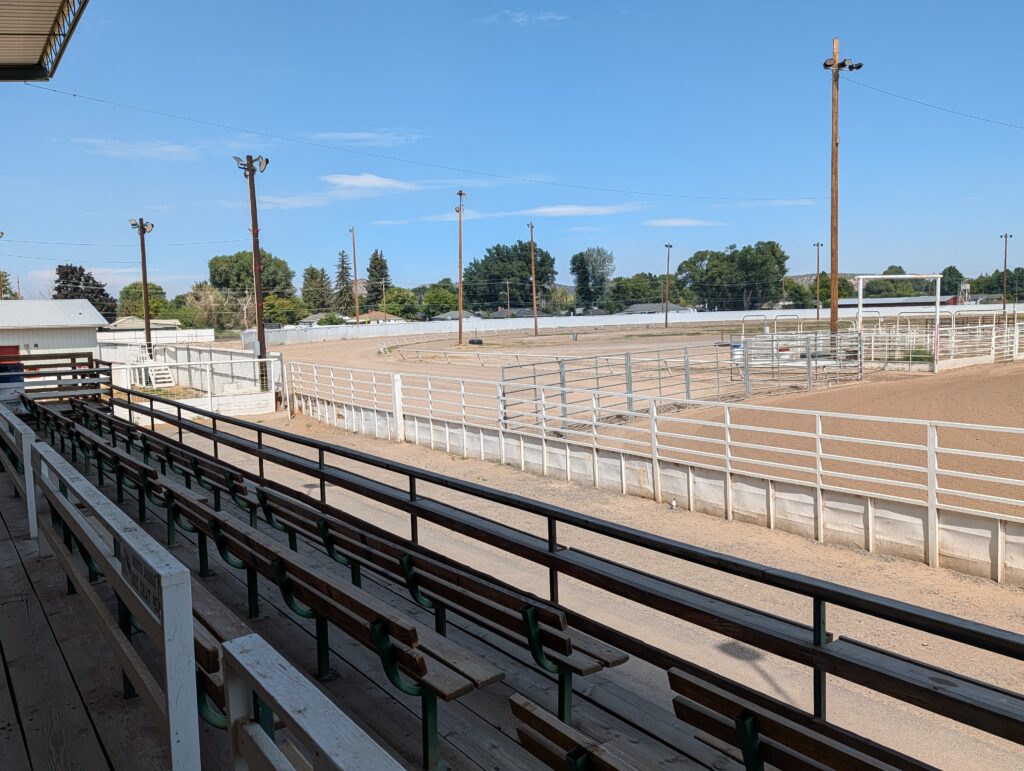
The private organization operates the annual horse races at the county-owned fairgrounds.
Hermreck said transferring the grant could allow more of the $1 million to actually be spent on racing improvements while reducing administrative costs and financial exposure to Crook County.
County Manager Will Van Vactor said administering the grant would require staff time for reporting and oversight. Hermreck said county finance officials estimated those administrative costs could reach approximately 10 to 15 percent — or between $100,000 and $150,000.
County Counsel Eric Blaine also warned that Crook County would ultimately remain responsible to the state if it signs the grant agreement.
Blaine said the legislation authorizing the money and the subsequent grant agreement do not appear to say precisely the same thing, while DAS has advised county officials it will not modify the agreement.
If Crook County signs the agreement and later fails to comply with its requirements, Blaine told commissioners taxpayers could ultimately be responsible for repayment.
Smith pushed back on some of those concerns and argued the county has already lost months in which improvements could have been underway.
One of his primary concerns is a turn on the south end of the racetrack that he said creates a recurring safety problem for horses and riders.
Smith said he would have preferred for Crook County to accept the grant and allow the Roundup to administer the projects and complete required reporting.
“We could have had this money six months ago,” Smith said, adding that improvements could already have been underway ahead of the 2027 races.
Smith also warned commissioners that going back to lawmakers creates another risk: there is no guarantee the Legislature will agree to rewrite the appropriation.
Later in the discussion, Smith expressed broader frustration over how the grant has been handled.
“There was some back room stuff going on on this that has just been frustrating,” Smith said. “Make a decision. Let’s get it going one way or the other.”
Commission Chair Seth Crawford appeared interested in pursuing both options.
Crawford asked Blaine to determine whether Crook County could accept the grant and enter into some type of agreement with the Crooked River Roundup that would sufficiently protect the county from financial liability.
At the same time, commissioners discussed beginning preparations for a possible legislative change that could put the grant directly with the Roundup if no workable contractual arrangement can be reached.
No formal action was taken Wednesday.
Hermreck confirmed near the end of the discussion that there would be no motion, while Blaine said county officials would continue researching the issue and bring it back before commissioners, potentially with a draft letter supporting legislative action.
Officials also hope to obtain written clarification from DAS or the Oregon Racing Commission about whether Crooked River Roundup can directly receive and administer the money without Crook County remaining financially responsible.
The matter is expected to return before commissioners next week.
Mr. Alderman is an investigative journalist specializing in government transparency, non-profit accountability, consumer protection, and is a subject matter expert on Oregon’s public records and meetings laws. As a former U.S. Army Military Police Officer, he brings a disciplined investigative approach to his reporting that has frequently exposed ethics violations, financial mismanagement, and transparency failures by public officials and agencies.