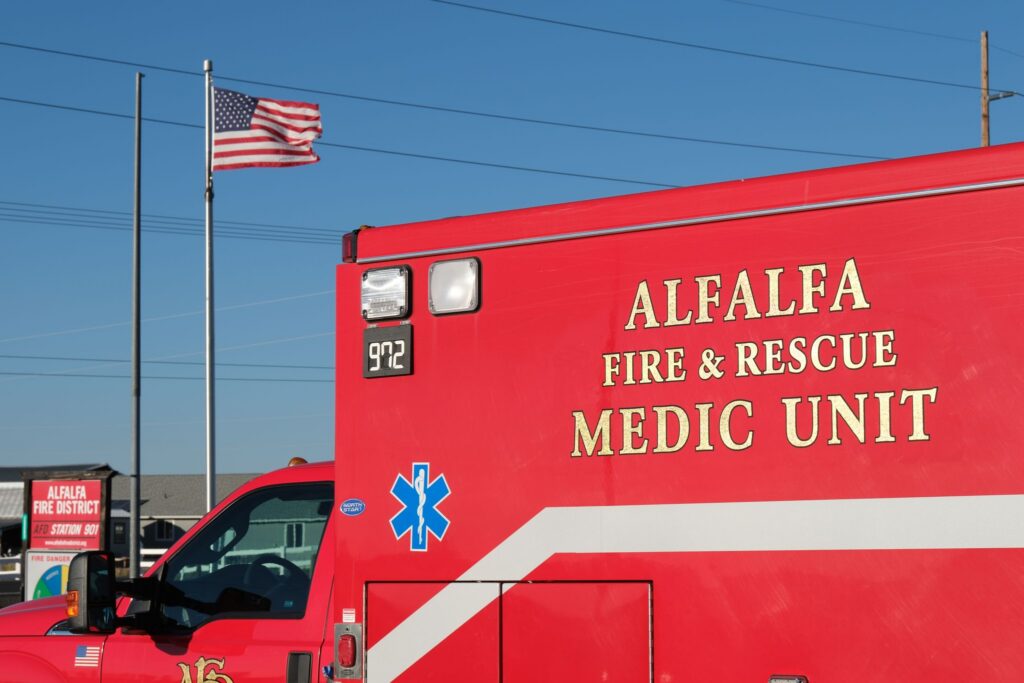
Bend, Ore. — The Alfalfa Fire District’s sale of a taxpayer-owned ambulance to Central Oregon Community College (COCC) for $15,000 is facing new scrutiny after records obtained by the Prineville Review revealed the college had apparently already paid the district before the vehicle was offered through a public auction that ultimately drew no other bidders.
The August sale followed an earlier effort by district Director Mark Laucks to sell the ambulance directly to COCC for the same amount. However, following discussions involving district legal counsel, officials reportedly determined the vehicle needed to be offered through a competitive public sale.
Despite that decision, COCC ultimately purchased the ambulance for $15,000 as the only bidder when the GovDeals auction closed Aug. 14th.
Records provided by the college have not established that a separate payment was completed through GovDeals, which required a wire transfer and an additional 12.5% buyer’s premium, bringing the total purchase obligation to $16,875. The records also do not establish that the earlier $15,000 payment made directly to Alfalfa Fire District was refunded or reversed.
The auction itself contained several notable omissions, including failing to identify the vehicle as an ambulance, providing no odometer reading and offering almost no information about its equipment or condition.
Former Fire Chief Chad LaVallee was also listed as the district’s contact for the auction, despite his resignation having taken effect June 30th, more than six weeks before the sale.
Alfalfa Fire’s provided financial records show no record of payment from COCC or GovDeals as well.
The transaction comes amid broader scrutiny of the district’s financial management and LaVallee’s continued involvement in district operations following his resignation.

COCC had been using ambulance under informal arrangement
Emails obtained from COCC show that the ambulance had previously been provided to the college for use in its emergency medical services training programs under an informal arrangement involving then-Chief LaVallee.
The arrangement apparently lacked a formal intergovernmental agreement (IGA) or documented authorization from the district’s board of directors.
In a May 29th email to other college personnel, COCC EMS Program Director Michael Greene acknowledged concerns about the arrangement after the ambulance had been returned to the district.
“The Alfalfa ambulance has gone back to its home. I know Chief Lavelle has offered to donate the rig but I’m feeling uncomfortable holding on to vehicle on a handshake with a former chief,” Greene wrote.
In a subsequent June 1st email, Greene further described the arrangement, writing, “Really there was no discussion to have. It’s been my responsibility and ‘hand shake’ from the onset.”
The correspondence indicates that COCC personnel themselves recognized the informal nature of the arrangement. Available district meeting minutes do not identify any board authorization allowing the college to use the publicly owned ambulance or establishing terms governing its possession, insurance and maintenance.
The proposed sale later came before the district’s board through an unexpected agenda item advanced by Laucks, who sought authorization to sell the ambulance to COCC for $15,000.
According to a source who spoke with the Prineville Review on the condition of anonymity, the proposed price had been advanced by Laucks at the direction of LaVallee, who was no longer serving as chief. It also matched the $15,000 amount the district recently purchased a water tender from Bend Fire & Rescue for.
In a July 6th email, Greene informed COCC leadership that the district’s board had formally authorized the sale.
“The Alfalfa Fire District Board has now formally authorized the sale of this ambulance to COCC for $15,000, which represents an exceptional value,” Greene wrote.
The correspondence also identified the proposed sale as having been authorized under district Resolution 2026-10.
Greene previously described the opportunity in a June 24th email as uncommon, saying the ambulance was known to the college, immediately usable and available at a fraction of the cost of a new vehicle.
COCC had been seeking a replacement for an aging 1997 training ambulance that Greene said had experienced repeated mechanical problems.
District had no adopted rules governing surplus property sales
Following meetings in July involving district legal counsel Jered Reid, officials reportedly determined that the proposed direct transaction could not proceed as originally planned.
Instead, the ambulance would need to be offered through a competitive public sale intended to obtain the best possible value for taxpayers.
The decision came amid a separate issue involving the district’s lack of adopted rules governing the disposal of surplus property.
Under ORS 279A.185, local public agencies may sell, transfer or otherwise dispose of personal property in accordance with rules adopted under ORS 279A.070. However, the Alfalfa Fire District had not adopted its own rules governing such transactions.
Oregon law also provides under ORS 279A.065(5) that public contracting agencies without their own properly adopted contracting procedures are subject to the Oregon Attorney General’s model rules.
The absence of locally adopted rules does not, by itself, establish that the sale was unlawful. The applicability of particular model rules and other statutory provisions would depend on the transaction and whether an exemption applied.
Oregon law also provides certain exceptions for transferring publicly owned equipment. ORS 279A.190 specifically allows qualifying transfers of fire protection equipment between regularly organized fire departments without competitive bidding, subject to several requirements.
COCC, however, is a community college and does not qualify as a regularly organized fire department under that provision.
Other provisions, including ORS 279A.025, recognize certain transactions between public agencies and intergovernmental agreements that may be exempt from ordinary public contracting requirements.
Nevertheless, district officials reportedly concluded that a public sale was necessary in this instance.
In a July 16th email to Laucks, COCC Dean of Career and Technical Education Grant Ermis indicated the college preferred completing the purchase directly rather than through GovDeals.
“We have the funds identified, and our business office believes doing a direct transaction would be the simplest way to purchase the ambulance, instead of the govedeals.com purchase we did for the fire engine,” Ermis wrote.
On July 20th, Laucks responded that a direct transaction would be easier but that the district would need to proceed with a public listing.
“Unfortunately, we are required to offer surplused apparatus on a public platform such as GovDeals first to ensure important public transparency,” Laucks wrote.
He also told COCC that he would prepare the vehicle information and photographs for the auction.
“I will soon prepare the vehicle’s details and pictures for listing on GovDeals, and I can keep you posted on when the listing goes live,” Laucks wrote.
Ermis responded that the college would work within those requirements and awaited notice that the listing was available.
The emails establish that both the district and college were aware of the decision to pursue a public sale rather than proceed with the original direct transaction.
COCC apparently paid $15,000 before auction was completed
Despite the July 20th communication, payment records indicate that COCC issued $15,000 directly to the Alfalfa Fire District within days, before the ambulance was subsequently sold through GovDeals.
The auction closed Aug. 14th at 2:11 p.m., with COCC Academic Affairs identified as the winning bidder at $15,000.
The college was the only bidder.
The auction’s bidding history also indicates that the sale closed almost immediately after COCC submitted its $15,000 bid, leaving little apparent opportunity for competing bids once the college entered the auction.
The timing is particularly notable given that COCC had already arranged to purchase the ambulance for that same amount and had apparently issued payment directly to the district weeks earlier.
The GovDeals buyer’s certificate imposed an additional $1,875 buyer’s premium, bringing the total amount due to $16,875. It also identified wire transfer as the only permitted payment method and required the transaction to be completed electronically within five business days.
However, the records provided by COCC have not established that a separate payment was made through the auction process.
The college has not identified or produced a receipt documenting a subsequent wire payment, and the records reviewed do not show that the earlier $15,000 payment was returned or reversed.
The discrepancy leaves the final payment arrangement unresolved, including whether the original direct payment was ultimately used to complete the purchase outside the GovDeals payment process.
The buyer’s certificate confirms that COCC won the auction but does not establish that the required payment was completed.
The Prineville Review sought comment from COCC concerning the payments and circumstances surrounding the sale, but the college had not responded prior to publication.
Auction listing omitted ambulance designation and odometer information
The auction listing itself provides additional concerns about how the district advertised the vehicle to potential buyers.
Rather than identifying the vehicle as an ambulance, the GovDeals listing was titled “2016 Ford F-350 SD XLT DRW 4WD.”
The accompanying description identified the vehicle as a regular-cab, two-door Ford pickup with a 6.7-liter diesel engine.
Neither the title nor the description identified the vehicle as an ambulance.
The listing also omitted the vehicle’s current odometer reading, stating “Miles (Accurate, As Visually Inspected),” with the buyer’s certificate expressly stating “Not Provided” under the meter information.
No detailed information was provided about the ambulance conversion, medical equipment, operational condition or maintenance history.
The missing information is particularly relevant to the vehicle’s potential value. Mileage, mechanical condition and the condition of its specialized equipment are among the factors that prospective buyers would ordinarily consider when evaluating a used ambulance.
The omission of the ambulance designation also could have affected whether prospective buyers searching specifically for used ambulances would have discovered the listing.
Photographs accompanying the auction were reportedly taken at a COCC facility, including images showing another fire services truck in the background.
The photographs appear to have been taken while the ambulance was in the college’s possession, although the available records do not establish when it was returned to COCC following Greene’s May email indicating the vehicle had gone back to the district.
Laucks had previously told COCC that he would be preparing the vehicle information and photographs.
The auction’s original publication date and duration were not immediately available.
Combined with the listing’s limited description and missing odometer information, the apparent near-immediate closure following COCC’s bid raises further concerns about whether the auction provided a meaningful opportunity for competitive bidding.
Sale price and vehicle valuation
The $15,000 sale price also raises concerns about how the district determined the ambulance’s value, particularly given COCC officials’ own estimates of what comparable vehicles typically cost.
In a June 24th email to college leadership, COCC EMS Program Director Michael Greene estimated that used ambulances typically cost between $75,000 and $100,000, while new ambulances cost between $250,000 and $400,000.
“Typical USED ambulance $75-100K,” Greene wrote. “New ambulance $250-400K.”
He then emphasized the opportunity being offered by the district.
“The agency, Alfalfa Fire, is offering their used vehicle for $15K,” Greene wrote. “We are familiar with the vehicle. It is in awesome condition. 100% safer for our students.”
Greene’s assessment is particularly notable because the college had previously used the ambulance for training and was familiar with its condition.
In a separate July 6th email, Greene described the district’s approval of the $15,000 sale as representing an “exceptional value.”
During the June 30th district board meeting, Laucks identified the vehicle as a 2016 North Star ambulance valued at $15,000. However, the Prineville Review has not identified an independent appraisal, comparable sales analysis or other documented valuation supporting that figure.
While Greene’s estimates do not establish the actual fair market value of this particular ambulance, they demonstrate that COCC officials considered the proposed purchase a substantial bargain compared with the typical cost of acquiring a used ambulance.
The district also had no adopted rules governing surplus-property sales.
The subsequent GovDeals auction provided little evidence of the vehicle’s potential value in a competitive market. The listing failed to identify it as an ambulance, omitted its odometer reading and provided little information about its equipment or condition.
COCC ultimately purchased the vehicle as the sole bidder for the same $15,000 amount originally proposed for the direct sale.
LaVallee contact for GovDeals auction despite earlier resignation
The GovDeals buyer’s certificate also identified former Chief Chad LaVallee as the Alfalfa Fire District’s seller contact, including his district email address and telephone number.
The designation appeared on paperwork generated after the Aug. 14th auction, more than six weeks after his resignation as chief became effective June 30th.
The records do not establish whether LaVallee personally administered the auction or whether his contact information remained associated with the district’s GovDeals account.
However, his continued identification in the transaction follows other instances in which LaVallee remained involved in district business after his departure.
The Prineville Review previously reported that firefighting equipment supplier MES/SeaWestern was owed approximately $165,000 for equipment ordered under LaVallee’s leadership, despite the district having received federal grant funding associated with the purchase.
Communications involving the company showed LaVallee continued discussing the outstanding obligation after resigning, including requesting that the amount be divided into separate invoices.
One invoice totaled approximately $119,765, with another approximately $45,000 remaining.
Laucks later sought board approval to pay the larger invoice during a meeting where the matter had not been properly listed for action. District legal counsel advised against proceeding.
LaVallee was also subsequently identified as serving in a training director position following his resignation, an appointment reportedly made by Laucks without formal board approval.

Mr. Alderman is an investigative journalist specializing in government transparency, non-profit accountability, consumer protection, and is a subject matter expert on Oregon’s public records and meetings laws. As a former U.S. Army Military Police Officer, he brings a disciplined investigative approach to his reporting that has frequently exposed ethics violations, financial mismanagement, and transparency failures by public officials and agencies.