



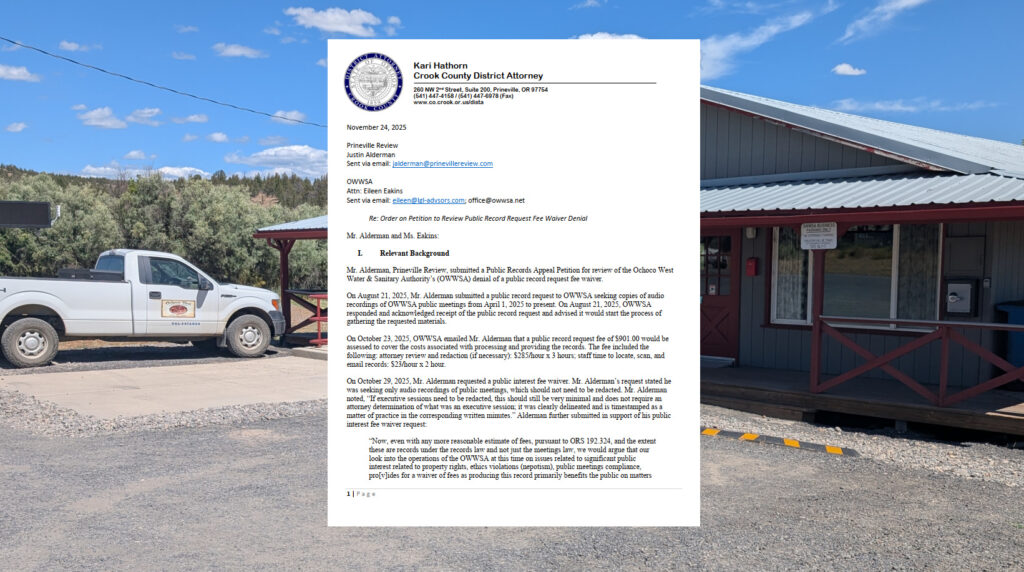
Crook County, Ore. – The Prineville Review has prevailed for the second time in recent months in a public records appeal petition to the Crook County District Attorney, securing an order requiring the Ochoco West Water & Sanitary Authority (OWWSA) to release a few months of recordings of its board meetings. The order came after the OWWSA’s repeated delays, often by ignoring the request for months.
Crook County District Attorney Kari Hathorn’sruling granting the petition, issued Nov. 24th, not only requires the OWWSA to waive all fees and produce the records by Dec. 5th, but also requires OWWSA to pay a $200 statutory penalty to the Prineville Review.
The penalty—an option that can be requested as part of records petitions in recent years under a law that was passed by the Oregon legislature—was intended by state lawmakers to help deter unreasonable delays and bad-faith handling of public records by public bodies that required petitions to the DA’s and the Oregon DOJ.
The case is completely separate from alawsuit filed in late October by the Prineville Review’s attorneys alleging OWWSA failed to comply with DA Hathorn’s earlier August order stemming from a separate July 21st public records request for communications between OWWSA board members. OWWSA was served with the complaint on Nov. 7th and has until Dec. 6th to respond. Eileen Eakins, principal attorney with LGL Advisors, has provided notice to an attorney for the Prineville Review acknowledging the complaint and representation for the OWWSA.
DA order comes after delays, excessive fees, and a lack of consideration by the OWWSA
The most recent records dispute began on August 21st, when the Prineville Review requested meeting recordings dating back to April. The request, while subject to the public records law, had primarily focused and requesting that the OWWSA make them publicly available under a separate requirement under the meetings law (ORS 192.650).
The OWWSA quickly acknowledged receipt, but then issued no further communications for nearly two months—well beyond Oregon’s maximum 15-business-day deadline for completing a response. The response even stated it would take a few business days to compile the request.
“Thank you for your public records request. We acknowledge receipt and we will start the process of gathering the requested materials. Please allow a few business days for us to compile and prepare the records for delivery,” read a response from the OWWSA.
We then received no further updates, clarification requests, or fee notices during that period, despite statutory requirements under ORS 192.324 and 192.329.

The Prineville Review responded: “Please note the request is not just a public records request, but a request to comply with ORS 192.650 and make the recorded minutes publicly available.”
When OWWSA’s staff finally responded again on October 23rd, it demanded a shocking $901 for the recorded minutes, including three hours of attorney time it claimed was required to “review”.
“In accordance with our policy and under the guidance of our legal counsel, we are able to fulfill your request in part or full, as determined by our attorney. Please note that a fee of $901.00 will be assessed to cover the costs associated with processing and providing the requested records,” the OWWSA stated two months later.
It went on to outline this included 3 hours of “attorney review and redaction (if necessary)” at the rate of $285 per hour, and 2 hours of “staff time to locate, scan, and email records” at the rate of $23 per hour.
“These charges are consistent with our standard records access procedures,” the OWWSA stated.
The fee demands for the often-ignored records requests also only started coming days after DA Hathorn’s similar August order in response to our first public records petition related to an earlier July 21st records request.
Around this time, the OWWSA Board acknowledged that the Oregon Government Ethics Commission had launched a preliminary investigation into its current and even former members for separate issues involving a slew of public meeting issues between late last year and this summer, much of which was contained in a public meetings grievance submitted by the Prineville Review that the OWWSA had also failed to respond to before its deadline.
It also came shortly after our questioning involving alleged nepotism involving current OWWSA manager Jamie Helms, who reportedly oversaw the part-time work by her spouse, Crystal Helms. That revelation came to light amid the other growing scrutiny after internal financial documents were released by an unknown whistleblower to the Prineville Review, records which showed details not available in bank statements previously provided in response to records requests by the OWWSA.
When we asked members of the board, including Chair Dan Parks, if the recorded minutes may reveal issues related to public meetings subject to the OGEC’s preliminary investigation, they declined to comment.
This publication immediately challenged the $901 fee as excessive and unnecessary, noting that it had requested only open-session audio and that the district’s own meeting minutes clearly list timestamps for entering and exiting executive sessions, should it have used a single recording for the public and executive sessions (which we learned it did after later claims during a public meeting).
The Prineville Review argued that the district cannot charge attorney time to review records not covered by exemption statutes, and recorded minutes of public meetings do not meet that requirement. Portions of executive session meeting minutes can qualify for absolute or conditional exemptions, with the latter being overridden with clear public interest arguments, but that was not part of the request as repeatedly clarified for the OWWSA.
The request, which this publication pointed out was the most simplistic of all of our recent requests, was oddly the most expensive of the fee demands made by the OWWSA in late August.
A late October public meetings grievance was filed after the OWWSA also tried to charge the Prineville Review to cover its costs to upload past meeting minutes for 2022 to the present to its website in order to comply with public meetings requirements, citing the separate records law to apply the fees.
Our October 28th public meetings grievance also went on to raise fairness issues with its application of public records fees for requirements under the separate meetings law.
“To require payment under the records law simply to fulfill its requirement for the public at large to comply with ORS 192.650 is even further disengerious and attempts to make the news media cover expenses for a functional requirement under the law,” wrote the Prineville Review.
Within a week, the OWWSA uploaded the past minutes and claimed it was “committed to transparency” and “accountability” after speaking with an attorney with the Special District’s Association of Oregon (SDAO).
“We are writing to confirm that the board meeting minutes from 2022 to the present have now been made publicly available on our website,” the OWWSA wrote. “Following consultation with legal counsel at SDAO, we were advised that publishing these records online would constitute best practice.”
After unsuccessful verbal pleas for the OWWSA board to intervene and waive or reduce fees, including highlighting potential conflicts of interest for both Helms and Parks’ handling of the requests themselves due to the nature of the requested records, the Prineville Review submitted a formal public-interest fee waiver request on October 29th in writing. Director Aiden Humphrey, who has repeatedly questioned the district’s response to recent controversy and records requests, had also reached out in an effort to better understand our request. Still, OWWSA made no further reply.
The Prineville Review then filed a public records appeal petition with District Attorney Kari Hathorn on Nov. 17th. Only then did OWWSA remove the attorney-review charges and issue a revised estimate of $75, which it attempted to characterize as a “reduction” that it claimed was also satisfying the public-interest waiver criteria, while in the same email (that was also copied to DA Hathorn), saying it was also denying the public interest fee waiver request.
It also didn’t explain how it came up with the $75 of staff time, when it had previously been more detailed in its estimate that claimed hourly staff time was at the rate of $23 per hour, totaling $66 for two hours, which under the revised estimate would include an oddly calculated 3.26086 hours of staff time if a total of $75.
In its rebuttal to the DA, the Prineville Review argued that Oregon law requires a two-step process:
(1) a public body must determine whether disclosure is in the public interest, and
(2) if so, determine whether a fee waiver or reduction is appropriate under the totality of the circumstances.
“[T]he [OWWSA] is still not complying with the requirements for appropriate consideration of a public interest fee waiver, as we argued in our petition, which it should be providing appropriate consideration for after having made a correction to its fee estimate,” this publication wrote in its rebuttal response.
“The fact that the [OWWSA] did not even revise its (now self admitted) excessive fee demand until the filling of this appeal petition, despite Petitioner having raised both a challenge to the fee estimate on its face, as well as making the public interest fee waiver request, and the district seemingly now denying the fee waiver request simply because it made a correction to that estimate, [i]s not in keeping with the requirements for due consideration under the law.”
This publication further pointed out that had the district responded in good faith, we did not believe we would be at this point in the process.
“Had the [OWWSA] provided appropriate consideration and even just a reduction, we are certain we would not be at this stage in the process, and hope the relief requested will prevent the OWWSA from its clear continued frustration under the [records law].”
Eakins, OWWSA’s attorney, also appeared to imply our fee waiver request was not made until the petition itself, or simply failed to acknowledge our exhibit showing the earlier requested waiver, and appeared to cite that we also simply stated a “public interest” without actually articulating the public interest applicable to the request.
“[The Prineville Review] has stated that a fee waiver ‘is in the public interest,’ therefore, presumably, he does not agree to the fee and no payment has been received,” wrote Eakins.
The Prineville Review then again pointed out the earlier public interest fee waiver request made on Oct. 29th did, in fact, provide clarity as to the public interest, which stated:
“…our look into the operations of the OWWSA at this time on issues related to significant public interest related to property rights, ethics violations (nepotism), public meetings compliance, pro[v]ides for a waiver of fees as producing this record primarily benefits the public on matters of governmental operations and public trust amid current ongoing controversy and the discovery of records supporting the previously mentioned issues. The Prineville Review is a publication of Western Media Group, a general-interest news organization that is primarily engaged in news reporting and has meaningful means to disseminate information to the public at no cost.”
We went on to also explain: “Additionally, the OWWSA took two months to even respond and acknowledge the request, thus causing significant frustration under the [records law] (and [meetings law]) in violation of the timeline requirements under ORS 192.324 and ORS 192.329. This further supports the justification for a complete waiver of any fees in this matter.”
The Prineville Review also emphasized in its rebuttal during the petition process that OWWSA cannot substitute the correction of an excessive fee—a correction compelled only after the DA petition was submitted—for proper public-interest consideration. We further argued that the district’s delays, failure to communicate for nearly two months, and refusal to engage in the waiver process for another month demonstrated an absence of good-faith compliance with the law.
DA Orders Release by Dec. 5; OWWSA has a limited time to raise a legal challenge
District Attorney Hathorn agreed. In her written order, she also found that OWWSA failed to show its fee was tied to actual cost, identified a clear public interest in the recordings, and thus concluded the district had not met its burden to justify either the original $901 fee or the revised $75 estimate.
“The public body bears the burden of demonstrating that its cost estimate to produce the records is reasonably calculated to its actual costs and must provide specific support for its assessment; that support generally includes an explanation of the reasonableness of the tasks undertaken and, if challenged, an explanation of how the wages paid to complete that task are themselves reasonable. Bong. v. Douglas Education Service District, 342 Or App 1 (2025),” wrote Hathorn, also citing legal precedent.
“I find there is public interest in the recordings of public meetings. In addition, I find OWWSA has not met its burden to show that its fee estimate is reasonably calculated to reimburse it for its actual cost to provide the records.”
Hathorn granted the Prineville Review’s petition in full, with the exception of granting more than seven days for disclosure of the records by Dec. 5th, due to the Thanksgiving holiday, which this publication also believed was acceptable.
“Petitioner’s Public Records Request Petition is GRANTED. Due to the upcoming holiday, I find it is reasonable to allow OWWSA additional time to provide the records. OWWSA shall provide responsive records by December 5, 2025. Either party may institute proceedings with the Crook County Circuit Court to seek review of my decision. ORS 192.407; ORS 192.431.”
Under Oregon law, if OWWSA wishes to contest the decision, it must provide notice within seven days and then file suit in Crook County Circuit Court within another seven days, or else it must comply and release the records by the DA’s deadline. The granted order also imposes a $200 penalty payable to the Prineville Review.
Editor's Note: We intend to allocate the penalty to our public records fund to support other government transparency reporting, although the costs incurred just to handle the petition, let alone repeated efforts seeking the OWWSA comply with the records law, unfortunately will well exceed this penalty amount.
OWWSA Board members have varying positions on recent controversy, records requests
OWWSA board members themselves have publicly questioned the district’s approach before the latest defeat. Director Aiden Humphrey expressed concern during a recent meeting that the district would be “wasting our constituents’ money in court” and suggested nothing discussed in open session warrants secrecy. He noted that Oregon law prohibits charging attorney time for determining whether something is a public record and said the district’s current practices risk further legal exposure.
Humphrey also referenced the specific request for recorded meeting minutes in raising his concerns with the board after we again argued the requirement to also release them per the meetings law, and not just the records law, only further added to the frustration and $901 fee demand.
“If these recordings are part of the public record anyway, then to charge someone who’d like to look at those for something that should already be a part of the public record doesn’t make sense,” said Humphrey.
Another unidentified board member questioned whether “bank statements” and employee records could be public—comments that highlighted confusion about Oregon’s limited records practice, which presumes disclosure unless a specific exemption applies.
During the same Nov 11th meeting, Board Chair Dan Parks suggested the district was increasing its reliance on attorney time in part because the Prineville Review had previously challenged OWWSA’s compliance through DA petitions, a recently filed lawsuit, and an unrelated complaint to the Oregon Government Ethics Commission (OGEC). Parks stated that these actions were part of the reason for the heightened fees—statements we also argued in its petition raise concerns of retaliation and viewpoint discrimination.
Parks made identical claims immediately following an earlier October meeting of the OWWSA Board, when Humphrey also raised concerns with the $901 fee that he also thought was excessive for just the recorded minutes.
Humphrey, referencing Oregon law, responded that attorney time cannot be billed simply to determine what is public, and urged his colleagues to take steps to avoid further litigation. His proposal did not advance to any formal vote as it did not appear to have the necessary support.
Another unidentified board member also explained that he couldn’t imagine how there were still requested records that had not actually been provided in response to our earlier records request.
Humphrey’s response highlighted that their own attorney had already been involved months earlier in their defense on the original August records petition with DA Hathorn.
“Well, I mean, the DA would disagree with that assessment. So [Eakins] had a chance to represent us when this when this case was originally filed with the DA, and when she filed that response, the DA ruled against our defense, ruled against our legal counsel, and said, ‘No’, that thing you’re doing to try to protect them from the requests of Western Media [Group], it’s not sufficient.”
Despite the DA’s previous order, Parks shockingly questioned Humphrey’s claim, saying, “Have you read that the DA said that?” to which Humphrey confirmed he had.
Another board member then said, “I haven’t seen that,” raising the question that Parks may not have even shared the DA’s past August ruling with the rest of the OWWSA Board. Humphrey’s may have only been aware of the DA’s earlier August ruling after we shared the news with him, although it was not immediately clear if he had become aware of the DA’s earlier order through other channels.
Parks had previously requested, and was granted, authority by the board to work with district manager Jamie Helms on handling the records requests. His request to the board came despite several of the records requests, including some that are still outstanding, seeking his own email records from his board email account. We previously reported on Parks’ statements to us, stating he would refuse to produce his emails and also admitting he used a personal email account for official district business, which he then claimed were not subject to the records law.
This publication has also raised concerns of First Amendment retaliation with the OWWSA Board as part of other public interest fee waiver requests based on the statements made by Parks justifying increased fees and attorney review on the basis of his displeasure with our investigations and complaints involving public records and meeting violations. The OWWSA has also so far ignored that request, leading to further statutory delays and prompting preparation for a potential third petition to the district attorney.
Separate lawsuit over earlier July public records order
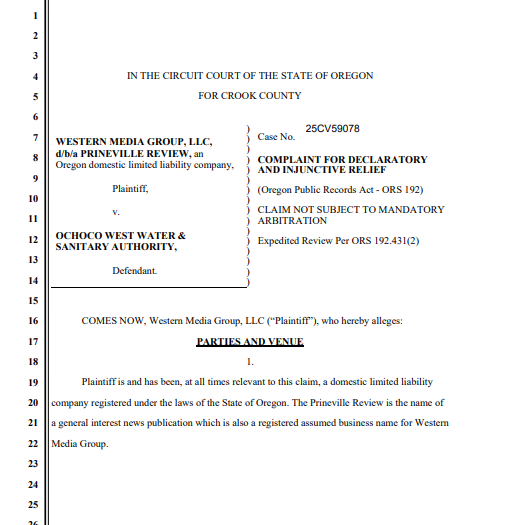
While prevailing in the recent petition, a lawsuit was filed by the Prineville Review‘s attorneys last month over an earlier DA public records order. That case stems from a completely separate public records request submitted July 21st with the OWWSA, which sought board-chair communications and records associated with the illegal and unregistered “Ochoco West Horse Coop”. When OWWSA failed to respond within the statutory deadlines, having not even responding to acknowledged the request, this publication petitioned Crook County DA Hathorn, who, on August 19th, ordered disclosure.
The Prineville Review told the OWWSA that it did not fully comply with the order, failing to produce all requested text messages and emails, having only provided emails for a few of the covered months as outlined in the request.
“We are working on gathering the public records you have requested. We are waiting for legal counsel to review some of the records you have requested. Our legal counsel is out of the office until next week, but we are continuing to gather information for all of your public records requests,” the OWWSA wrote in response.
OWWSA also failed to provide notice within seven days of any intent to seek judicial review, as required by ORS 192.411. Because of that failure, ORS 192.431 requires OWWSA to cover the Prineville Review’s legal fees in the lawsuit regardless of the case’s outcome.
Editor's Note: The legal complaint filed by attorneys for the Prineville Review is a declaratory and injunctive relief claim, as is standard for public records disputes with government bodies. It is not a complaint-seeking money award damages. An OWWSA Board member and other parties have falsely alleged the Prineville Review has launched dozens of lawsuits against public bodies as a "money-making scheme." To date, the Prineville Review has only now filed two legal actions related to public records and meetings issue involving public bodies, these complaints do not yield money damages, and only seek to require a public body to comply with the law (and pay legal costs). Public records lawsuits are one of the more common types for news media organizations.
Pattern of delays raises transparency questions
In recent months, the Prineville Review has published multiple articles highlighting ongoing investigations raising broader governance concerns at OWWSA, including findings of possible nepotism involving district leadership, unexplained financial and property-tax reporting questions, and unresolved issues surrounding the legal and operational relationship between OWWSA and the Ochoco West Property Owners Association (OWPOA).
The OWWSA also appeared intent on passing questionable restrictions on members of the press in reaction to some of the earlier reporting. Shortly after our story raised questions on the “media screening policy”, the planned agenda item was removed from the meeting’s agenda. OWWSA officials have refused to provide any information on the proposal.
The look into the slew of issues involving the OWWSA has only grown after more concerned citizens and former officials came forward to the Prineville Review since our initial look last year. That also included an unknown whistleblower dropping a trove of internal records with this publication, which, among them, also revealed a past investigation into reported misuse of public funds by the district’s former manager.
When we asked an existing source (who spoke on the condition of anonymity) if they knew about the reported investigation into the former manager, they claimed the board brushed the issues under the rug and kept them from the public. They also said they were not aware whether the district engaged in any self-reporting to state ethics officials or law enforcement. The OWWSA had also initially refused to provide records related to the third-party investigation involving the former manager, citing conditional exemptions that can be overridden by clear findings of public interest. After this publication made those arguments, the OWWSA relented (although months later) in part of the full exemption claim for the third-party investigation report, and demanded hundreds of dollars in fees to produce the records.
Our request for a public interest fee waiver earlier this month has not yet been considered by the district. Among this publication’s arguments is the district’s decision to ignore providing the required responses earlier in the process.
This is a developing story we will continue to keep you updated on.
Mr. Alderman is an investigative journalist specializing in government transparency, non-profit accountability, consumer protection, and is a subject matter expert on Oregon’s public records and meetings laws. As a former U.S. Army Military Police Officer, he brings a disciplined investigative approach to his reporting that has frequently exposed ethics violations, financial mismanagement, and transparency failures by public officials and agencies.




 to release a few months of recordings of its board meetings.)