

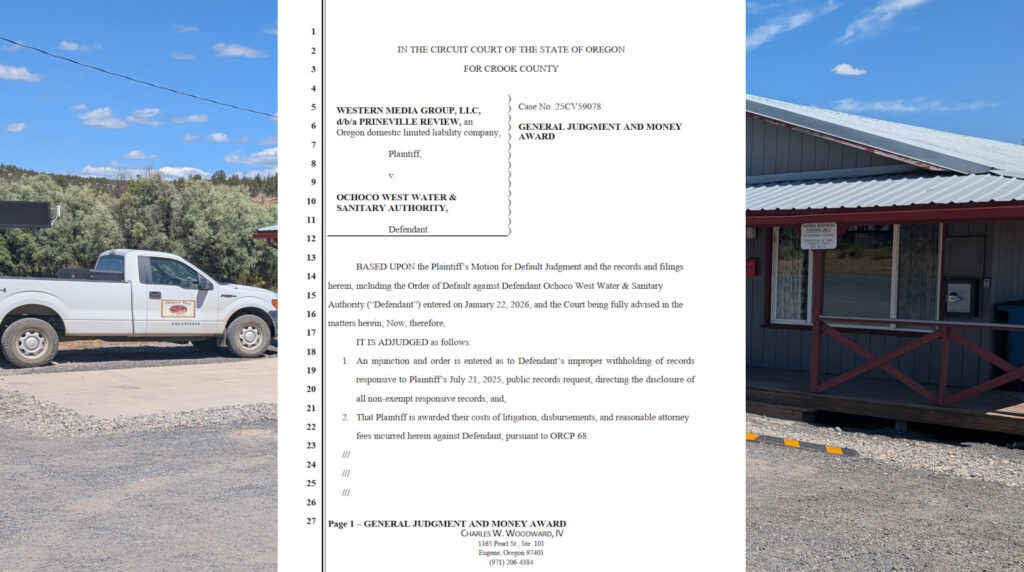
Prineville, Ore. – A Crook County Circuit Court judge has entered a default judgment and injunction against the Ochoco West Water and Sanitary Authority (OWWSA), ordering the district to release public records after it failed to respond to a lawsuit filed last fall by the Prineville Review.
The ruling, signed Jan. 27th, marks the first time a court has formally compelled the OWWSA to produce records amid mounting scrutiny over the district’s transparency, public meetings compliance, and governance practices—issues that are also the subject of an ongoing Oregon Government Ethics Commission investigation.
The lawsuit, filed in late October, stemmed from OWWSA’s failure to fully comply with a Crook County District Attorney order requiring the release of records requested under Oregon’s Public Records Act. The requested materials included communications from the board chair to other board members regarding the scheduling and agendas of meetings held in May, June, and July 2025.
The records also relate to the same set of meetings currently under investigation by the OGEC.
Court records show that OWWSA was properly served with the complaint but failed to file an answer or otherwise appear in the case within the time allowed by law. As a result, the court entered an order of default in January, followed by a general judgment granting injunctive relief.
Under the judgment, OWWSA is enjoined from continuing to withhold non-exempt public records responsive to the request and is ordered to disclose all such records. The court also ruled that the Prineville Review is entitled to recover its litigation costs and reasonable attorney fees, with the amount to be determined in subsequent court proceedings. No other money award was made to the Prineville Review, or requested.
Although OWWSA did not respond to the lawsuit itself, the district did issue a procedural notice under Oregon Rules of Civil Procedure 69, requiring a 10-day warning before a default judgment could be sought. This publication’s legal counsel informed the OWWSA’s attorney that it intended to do so, which would have still allowed a motion for default by late November.
After the default window had opened, OWWSA produced additional responsive records related to this complaint that its board and staff had previously claimed didn’t exist. However, those disclosures remained incomplete, and communications sought in the original request—particularly text messages between board members—were still not fully produced. According to court filings, further efforts by OWWSA or its legal counsel to supplement the production ceased thereafter.
The case traces back to a July 2025 public records request submitted by the Prineville Review as part of its ongoing reporting into OWWSA’s governance and operations. When OWWSA failed to timely respond, the publication petitioned the Crook County District Attorney for review. The district attorney ordered OWWSA to release the records, but the district did not fully comply within the statutory deadline and did not initiate court proceedings to challenge the order.
Under Oregon law, a public body that fails to comply with a district attorney’s public records order or indicate that it intends to and actually challenges the requester in court is on the hook for the requester’s legal costs regardless of the case’s outcome.
The default judgment adds to a growing list of unresolved issues facing OWWSA. As previously reported by this publication, the district has been placed under investigation for repeated public meetings violations, deficient agendas, improper executive sessions, and failure to provide required public access and notice.
In December, the Oregon Government Ethics Commission voted unanimously to open formal investigations into current and former OWWSA board members after finding a substantial objective basis to believe violations of Oregon’s public meetings laws may have occurred. That investigation remains ongoing.
The district has also faced criticism from some ratepayers over governance practices, delayed audit reporting, and its handling of records and transparency obligations. Despite repeated opportunities to address those concerns, the district’s compliance issues have continued.
OWWSA has not publicly explained why it failed to respond to the lawsuit or how it intends to comply with the court’s injunction. The district has also not indicated whether it plans to appeal the order.
Within the last couple of weeks, the OWWSA Board has begun to intervene on other outstanding records issues, including requests seeking investigative records involving former district manager Ray Horton over his reported misuse of public funds for personal use. Horton reportedly was offered the opportunity to resign instead of being fired, according to sources who had spoken with the Prineville Review last year under the condition of anonymity.
Earlier this week, the OWWSA Board voted to release the records after one of its managers, Jamie Helms, declined to produce them, citing a conditional exemption under ORS 192.345, which came after months of delay. However, conditional exemptions are able to be overridden on matters of public interest, which this publication argued. The district’s staff then said they would release the records, but wanted over $500 in fees.
After the OWWSA Board also waived those fees, Helms again declined to release the records and again claimed they were exempt after consulting with legal counsel. That prompted the Prineville Review to appeal directly to the board on Tuesday during a special meeting before moving to challenge the decision in a petition with the Crook County District Attorney.
The board voted following its executive session to release the records in response to the public interest argument, a decision that signals a potential about-face from its past handling of public records requests. As of the time of publication, we were still awaiting production of those investigation report records.
Note: This story was updated following initial publication to improve clarity on the recent vote by the OWWSA Board regarding the release of investigatory reports.

Mr. Alderman is an investigative journalist specializing in government transparency, non-profit accountability, consumer protection, and is a subject matter expert on Oregon’s public records and meetings laws. As a former U.S. Army Military Police Officer, he brings a disciplined investigative approach to his reporting that has frequently exposed ethics violations, financial mismanagement, and transparency failures by public officials and agencies.



, ordering the district to release public records after it failed to respond to a lawsuit filed last fall by the Prineville Review.)