The Oregon Journalism Project has learned that an Oregon Court of Appeals judge who sided with PacifiCorp in a case brought by thousands of rural Oregonians caught in the 2020 Labor Day wildfires represented the utility giant for years before she left private legal practice.
Judge Anna Joyce led a three-judge panel that threw out a huge verdict against PacifiCorp on April 8. She wrote the 34-page decision overturning lower court judgments.
If that ruling stands, the electric utility could avoid paying billions of dollars to wildfire victims.As a private attorney, Joyce represented PacifiCorp for much of the six years before her appointment to the bench in 2022.OJP spoke to experts who say Joyce’s role raises questions of judicial ethics. Oregon’s Code of Judicial Conduct states “a judge shall disqualify himself or herself in any proceeding in which a reasonable person would question the judge’s impartiality.”
No mention is made of a judicial conflict or Joyce’s prior representation of PacifiCorp in either a transcript of the oral arguments or in the case docket. Experts say she should have disclosed the connection—and stepped off the case.
“There’s no question that she should have recused herself,” says James Alfini, a retired law professor and law school dean. “Any reasonable person under those circumstances would question the judge’s impartiality.”
Alfini co-wrote a landmark book on judicial ethics. His Judicial Conduct and Ethics is required reading at many law schools. “It is certainly grounds for appeal,” Alfini says of Joyce’s role. “I imagine that the plaintiff’s lawyers are already going to the Supreme Court asking for that.”
The concern, of course, is that a judge might favor a former client. As there’s no way to determine definitively whether a judge did so, the rules are designed to eliminate any doubt.
Sometimes, judges can comply with the rule if they disclose the conflict to the parties in the case and everyone agrees disqualification is not warranted.

Joyce declined to comment as did officials at the Oregon Judicial Department. In a written statement, the department said: “Under Oregon’s Code of Judicial Conduct, judges have to participate in assigned cases unless disqualified. All judges routinely consider potential conflicts of interest before hearing a case, including those that may arise from the prior representation of a client.”
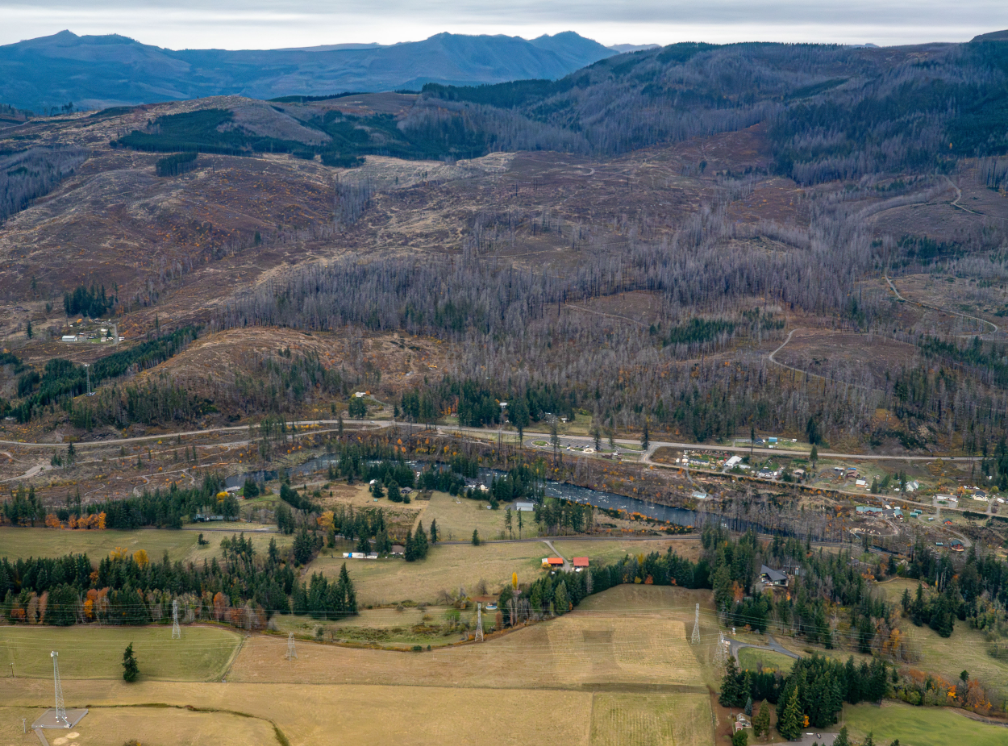
On Labor Day weekend in 2020, wildfires whipped by east winds ripped through PacifiCorp’s service area. In the aftermath, fire victims as well as representatives of seven people who died in Santiam Canyon filed liability lawsuits against the utility.
Attorneys for the victims claim PacifiCorp declined to turn off power lines before the fires despite dire forecasts. PacifiCorp argued the plaintiffs’ claims were overblown.
Many of the cases were consolidated as a class action suit in Multnomah County Circuit Court, which gave the plaintiffs’ attorneys considerable leverage.
A jury ruled in June 2023 that the utility had been grossly negligent and reckless. That first trial included 16 plaintiffs. Many more fire victims are waiting for their days in court—between 3,000 and 4,000, according to plaintiffs’ attorneys.
PacifiCorp, part of the Berkshire Hathaway conglomerate that Warren Buffett built, demanded that every plaintiff undergo a damages trial to determine the extent of their losses. So far, juries have awarded $1.22 billion to individual plaintiffs, an average of $6 million apiece.
Rather than paying those awards, the utility filed an appeal in April 2025, arguing the designation as a class action was improper because thousands of plaintiffs from four different fires had different experiences.
In her written opinion, Joyce agreed with PacifiCorp that Multnomah County Circuit Judge Steffan Alexander’s instructions to the jury were flawed. Alexander had told jury members they “may assume that the evidence at trial applies to all class members,” Joyce wrote. In this case, with four different fires and different circumstances, that jury instruction was “erroneous.”
The appeals court sent the case back to the circuit court for reconsideration. The plaintiffs’ attorneys declined to comment whether Joyce should have recused herself but say the appeals court erred. “We will be seeking immediate review from the Oregon Supreme Court,” the three firms representing clients in PacifiCorp lawsuits said in a joint statement.
People who lost their homes to the 2020 fires are less interested in legal niceties. The revelation that the key judge in their case had represented PacifiCorp left some plaintiffs fuming.
“Oh my God, I knew it,” said Chris Grom, whose home in Gates, Ore., burned in the Labor Day fires. “These people have tons of money. To them, we’re nothing,” she said. “I don’t care how many times they say they care about the community, They don’t…
“They’re talking about having to go back to trial,” Grom added. “ I don’t know if I can do that. It’s been six years.”
The PacifiCorp wildfire lawsuit is one of the most significant legal fights in recent Oregon history, and potential liability for the 2020 fires has left the fate of one of Oregon’s largest electric utilities hanging in the balance.
The utility disclosed last November that it faced a substantial cash crunch due in part to wildfire costs, which a utility watchdog group said could push PacifiCorp into bankruptcy.PacifiCorp has raised electricity rates seven years in a row and sold off assets—such as transmission lines and power plants—to raise nearly $3 billion in cash.
Anna Joyce is no stranger to big cases. From 2013 to 2015, she served as solicitor general of the Oregon Department of Justice, handling high-level appeals and constitutional litigation.
In 2015, Joyce left the state and joined Markowitz Herbold, one of the state’s premier litigation firms. She led the firm’s appellate practice and energy and utility group. By 2020, she had become the firm’s managing shareholder.
Markowitz representatives did not return phone calls or emails. But the firm described Joyce’s central role in its utility practice on its website circa 2021.
“For the past 30-plus years we have developed deep relationships with major players, including Portland General Electric, PacifiCorp and Clean Water Services,” the firm stated. “Led by the former Oregon Solicitor General Anna Joyce, our team has a formidable record of securing victories for our energy and utility clients….”
It’s not clear whether Markowitz lawyers played any role in the early stages of the wildfire cases. Lawyers from Stoel Rives in Portland and the Hueston Hennigan firm in Los Angeles defended PacifiCorp.
That changed recently when PacifiCorp brought in Markowitz lawyers to help with the many damages trials.PacifiCorp declined to comment on Joyce’s role but noted it has paid out about $2.2 billion in wildfire settlements to more than 4,500 people who did not join the class action.
Legal scholars agree judicial conflict cases are complex, but Stephen Gillers, a professor emeritus and legal ethics authority at New York University School of Law, says there is little wiggle room in Oregon’s judicial ethics code, which says judges whose impartiality is in doubt “shall” disqualify themselves.
“’Shall’ is mandatory,” Gillers says. “The judge has no discretion.”
Charles Geyh, a legal ethics expert at Indiana University’s Maurer School of Law, says if Joyce worked on the PacifiCorp wildfire case, she would have to disclose and disqualify herself. If she worked at Markowitz while other lawyers from the firm worked the PacifiCorp wildfire case, she would have to disclose and disqualify, he adds.
But if Joyce never worked on the case herself and she left Markowitz by the time the firm joined the PacifiCorp wildfire legal team, “she’s probably in the clear,” Geyh says. “That’s a hard thing to accept if you’re on the outside looking in. She knows these guys, she has worked for them repeatedly. That just looks bad.”
Oregon’s Judicial Fitness Commission reviews complaints against judges. It refers the most serious violations to the Oregon Supreme Court for possible disciplinary action.
The commission received 387 complaints last year. The Supreme Court sanctioned just two judges in the past eight years.
The commission recently got a new member—Appeals Court Judge Anna Joyce.
This story was produced by the Oregon Journalism Project, a nonprofit investigative newsroom for the state of Oregon. The Prineville Review became a partner of OJP in August of 2025 in order to bring our readers investigative reporting from across Oregon.

Jeff Manning
Jeff Manning came up through the ranks of Oregon newspapers to become one of the leading investigative reporters in the state. From 1994 to 2024 he worked at The Oregonian/OregonLive, where he specialized in covering money, business and the powerful.