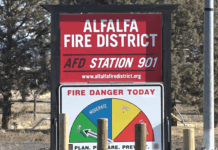
Alfalfa, Ore. — The Alfalfa Fire District Board of Directors adopted the district’s 2026-27 budget on June 30th, following a Budget Committee meeting one week earlier in which a committee member raised concerns that the proposal may not comply with Oregon’s Local Budget Law because it omitted historical expenditure figures required in budget documents.
The discussion occurred during the Budget Committee’s June 22nd meeting, where committee member Sarah Linden cited ORS 294.358 and language from the Oregon Local Budgeting Manual stating that detailed budget schedules “must show actual … resources and expenditures related to the preceding fiscal years.”
“This requirement provides a two-year record of what actually happened,” Linden said. “It allows a comparison of the earlier actual resources and expenditures with those estimated and budgeted for both the current year and upcoming fiscal year.”
Linden questioned whether approving the budget without those historical expenditure figures would place the district in violation of state law.
“By us saying yes, we’re going to move forward, and we don’t have those two years of actual spend, we are in violation,” Linden said.
The district’s appointed budget officer, Jered Reid, who also serves as the district’s primary legal counsel, responded that the district could not provide those figures because its required financial audits remain incomplete.
“They don’t have actuals to present because they don’t have an audit,” Reid said.
Linden then asked whether approving the budget without those figures could expose the district to additional legal liability.

“Does this potentially bring another violation or suit to the department by not including those?” she asked.
“Somebody can challenge the budget,” Reid responded. “Yes.”
Despite the discussion, the Budget Committee voted to recommend approval of the budget, with Linden casting the lone dissenting vote.
The Board of Directors subsequently adopted the budget during its June 30th meeting.
Whether completed audits are legally required before a district may report prior-year “actual” expenditures in its budget documents was not resolved during the meeting. Reid maintained that the district could not present those figures without completed audits.
A source familiar with Oregon municipal budgeting who works in accounting told the Prineville Review that local governments generally maintain accounting records reflecting actual revenues and expenditures independent of the annual audit process, and that those records are commonly used in preparing budget documents before an audit is often completed, otherwise many district’s would fail to comply with the requirements under Oregon’s budget law. The Prineville Review has not independently confirmed which interpretation applies under Oregon law.
Linden again echoed her concerns during yesterday’s board meeting when this publication asked the current board chair Mark Laucks if the board intended, prior to a vote to adopt the budget, to discuss the concerns raised by Linden. Laucks stated they did not intend to do so.
Linden’s dissenting vote during the district’s June 22nd Budget Committee meeting was an unusual occurrence in Oregon’s local budget process, where proposed budgets are rarely rejected or opposed at the committee level.
The issue comes as the district continues working to address years of overdue financial audits.
Laucks, along with board members Dustin Piggot and Carolyn Chase, all voted in favor of adopting the budget with little discussion. All three also served as members alongside the district’s hastily appointed budget committee, which started over after Reid had also reaffirmed that the district’s prior process in appointing budget committee members did not comply with the law.
During an April 8th, 2026, board meeting, now-former board chair Nate Starr stated that the budget committee appointments would be handled by him and now-former fire chief Chad LaVallee. The Prineville Review raised the issues in a formal public meeting grievance after a previous May 13th budget committee appeared without any public meeting or decision on the appointments. That evening also included a contentious board meeting.
As we previously reported, the district last year faced the possibility of dissolution by the Deschutes County Board of Commissioners at the direction of the Oregon Secretary of State after falling more than three years behind on its legally required annual audit reports.
The district had accumulated nearly four years of delinquent audits, continuing a pattern that repeatedly drew warnings from state and county officials over more than half a decade during the tenure of Chad LaVallee, the district’s now-former fire chief. The district has since begun efforts to bring those audits current.

Mr. Alderman is an investigative journalist specializing in government transparency, non-profit accountability, consumer protection, and is a subject matter expert on Oregon’s public records and meetings laws. As a former U.S. Army Military Police Officer, he brings a disciplined investigative approach to his reporting that has frequently exposed ethics violations, financial mismanagement, and transparency failures by public officials and agencies.