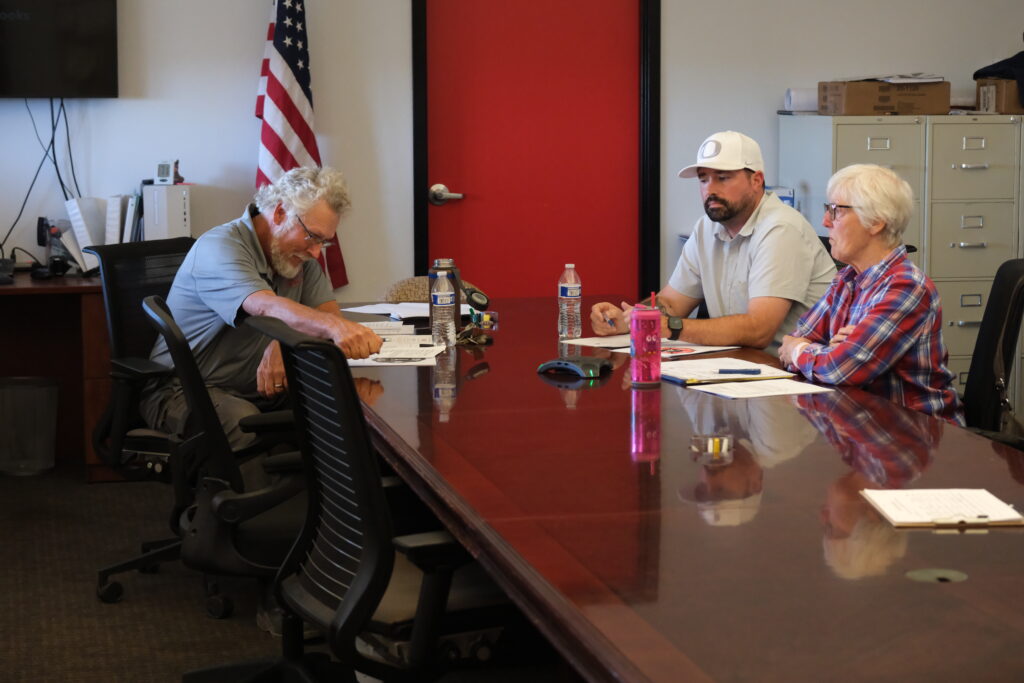
Alfalfa, Ore. — A group of 16 Alfalfa Fire District electors delivered a sweeping six-page rebuke of the district’s leadership this week during a public meeting that also saw two new directors appointed to the embattled board and raised new questions about the embattled former Fire Chief Chad LaVallee’s returning role in district operations.
The electors took turns using their individual public-comment periods to publicly read a coordinated statement raising concerns over financial management, transparency, district expansion, nepotism, ambulance operations and governance of the rural fire district.
Later in the meeting, the board appointed Melody Holliday and Robert Kathman to its two vacant seats. Board Chair Mark Laucks also identified LaVallee as the district’s new “Training Director,” but the authority behind his apparent appointment and the circumstances surrounding it are unclear.
The unusual presentation unfolded at the beginning of the meeting, where several residents used their respective three-minute public-comment periods to continue reading the statement where another elector had stopped. The group provided the Prineville Review with a copy of the undersigned statement, which you can read here.
Electors praise firefighters but criticize governance
Despite its sweeping criticism, the statement began by separating the district’s volunteer firefighters from those responsible for governing and managing the organization.
“First and foremost, we express our profound gratitude to our volunteer firefighters,” said Ole Olsen. “They are the true heroes of our community, and their dedication to our safety is invaluable.”
Their criticism instead focused primarily on decisions by district leadership.
The group argued that efforts to expand district services through short-term funding were undertaken without adequately considering their long-term costs or the administrative resources necessary to sustain them.

The statement alleged the district had “overextended its management capacity, bypassed critical legal requirements, and placed the financial and physical safety of the district in jeopardy.”
Among the issues raised were delinquent financial audits, the district’s training facility, its attempted expansion into Crook County and illegal taxing, ambulance operations, acquisition of a ladder truck, transparency and public meetings, nepotism concerns with the chief’s past hiring of his wife, and the practice of district firefighters simultaneously serving on the Board of Directors.
Electors refuse to abandon public reading despite attempts to stop its reading
Laucks repeatedly interjected as the reading continued and, early in the presentation, asked former board member John Brooks whether the group could instead summarize its concerns.
“We’re at time, John,” Laucks told Brooks as his individual three-minute period expired.
“All right, I’ll pass it off to someone else,” Brooks responded.
But Laucks continued, asking Brooks whether there was “a way to summarize that so we can work with it as an individual item?”
Laucks suggested reducing the group’s concerns to a single sheet containing individual problems and proposed solutions, noting that the board had already discussed many of the matters being raised.
Brooks responded that the full document could certainly be entered into the district’s record and addressed by the board at a subsequent meeting, but made clear there was a broader reason electors wanted their concerns publicly aired. The district’s legal counsel, Jered Reid, also noted the document could be submitted, which it had been moments earlier.
“The point is that there has been this systemic — little and big times — where the board has broken the law, and they’ve tried to blame the news media for bringing it to people’s attention as if they’re just annoying little things,” Brooks said. “These are state of Oregon laws.”
Brooks continued by arguing that the Alfalfa Fire District is fundamentally a rural volunteer fire district and that every additional program or service undertaken by the district increases its management responsibilities.
Laucks responded that the district was “already going in the right direction.”
Brooks again pushed back.
“But Mark, you’ve already told me that you don’t want anybody telling you that you’re doing things wrong,” Brooks said.
Laucks characterized that as a personal conversation and accused Brooks of a “breaking of privilege of trust” before attempting to move the public-comment period forward.
The electors nevertheless continued their coordinated reading.
Immediately after Brooks, who was the group’s second speaker, soon-to-be appointed board member Robert Kathman took over to read. Kathman was not even among the individuals who had undersigned the letter.
The reading of the statement continued. When one person’s time expired, the document was handed to another elector, who continued reading. The process repeated until the group made its way through the nearly six-page statement and its dozen recommendations.
Board members Dustin Piggott and Carolyn Chase largely listened quietly during the presentation without significant visible reaction. Laucks was noticeably more animated, repeatedly shaking his head and displaying other expressions, including grimaces and smiles, during portions of the testimony as cameras from the media turned toward the board. Unlike past meetings, where Laucks often allowed those less critical or positive of the district to speak well beyond a more recently established 3-minute limit, Laucks repeatedly looked down at a timer and quickly ended comments once each speaker reached their time.
Audits, annexation and ambulance operations questioned
The presentation also focused on the district’s delinquent financial reports, describing the situation as a “critical regulatory crisis.” The group of electors argued that the district’s repeated failure to complete required reports threatens its continued existence and criticized the board for allowing the delinquency to continue despite previous warnings.
Late last year, while investigating several other allegations against the district, the Prineville Review uncovered that the district was facing dissolution by the Deschutes County Board of Commissioners if the district did not immediately file at least one of its three (and almost four) past-due audit reports. The dissolution notice was prompted by the Oregon Secretary of State’s Audit Division, which told Deschutes County that it was required by law to act, according to a letter sent to the County in August of 2025.
Deschutes County Counsel David Doyle shared the letter they received with LaVallee in late August, and went on to say, “…if your district does not take remedial action ASAP, Deschutes County will be compelled by state law to initiate district dissolution.”
Despite those documents clearly showing state and county action, now-former fire chief Chad LaVallee, Board President Nate Starr, and still-serving board member Mark Laucks have repeatedly disputed the reports and have further claimed that reporting by the Prineville Review and KTVZ News was false.
The district shortly filed its 2022 audit report, followed by its 2023 report in the months after. Electors now raise concerns that the district will again be three years out of date and at risk of dissolution. The district is still delinquent on its 2024 and 2025 reports. Its 2026 report is due by the end of the year.
Another lengthy section criticized the district’s attempted expansion into the Juniper Acres area of Crook County. The electors alleged the process failed to adequately inform residents and existing district voters about annexation, exceeded statutory boundary-change limitations and resulted in some Crook County property owners being improperly taxed.
The electors also criticized the district’s ambulance and commercial medical transport operations, arguing the program relies on temporary grant funding while creating continuing expenses and taking personnel and equipment outside the district for transports between Redmond and Bend.
The group similarly called the district’s ladder truck an inappropriate use of limited resources, contending the apparatus was designed primarily for urban environments with taller structures and municipal hydrant infrastructure that does not exist within the rural district.
Former chief’s new role raises questions
The electors’ statement also revisited controversy surrounding former Fire Chief Chad LaVallee and the district’s employment of his wife.
The group characterized the arrangement as nepotism and alleged it exposed the district to ethics and grant-compliance concerns.
The concerns come while LaVallee remains the subject of state scrutiny, including an Oregon Government Ethics Commission investigation involving alleged violations of state ethics law.
Despite LaVallee no longer serving as fire chief, however, the meeting revealed that he apparently remains involved in district operations.
During an operations report, Laucks said several prospective volunteers had submitted applications and that he would direct them to the district’s training director.
When someone in the room asked who held that position, Laucks identified LaVallee.
“It’s going to be Chad [LaVallee] who is going to be a training director,” Laucks said.
No discussion followed explaining when or through what process LaVallee was selected for the position, who authorized the decision, what duties or authority come with the title, or whether the position is paid or volunteer.
Later in the meeting, however, Laucks created additional uncertainty about the district’s training structure when he said the district “currently” had two training directors and identified them as David McKenzie, a former Bend firefighter, and Tom Lewis, a former Sunriver captain. Laucks said both of those individuals were unpaid.
The apparent discrepancy was not resolved during the meeting, leaving unanswered exactly what position LaVallee now holds, whether “Training Director” is a formal appointment, and how his role relates to the two other individuals Laucks later identified as holding that title.
Those questions take on added significance because the electors’ statement specifically criticized decisions made during LaVallee’s tenure and called for greater board oversight of district operations.
LaVallee is also under investigation by both the Oregon Government Ethics Commission (OGEC) and the Oregon Secretary of State’s Elections Division. OGEC decided in February of this year, following a preliminary review, to launch a formal investigation into four counts of Oregon’s ethics law violations, including counts for nepotism and misuse of office provisions under ORS Chapter 244, tied to the hiring, supervision, and control of payments to his wife over the course of nearly three years.
A separate investigation into the district and its officials’ possible violations of Oregon’s prohibition on political advocacy laws also began in April.
Both investigations are still underway. OGEC is expected to complete its investigation around October 2026. No additional information or timeline is available on the investigation into the election law violations.
Building permitting issues and safety questions affecting firefighters and COCC students
The group also questioned the operation and permitting of the district’s live-fire training facility behind the Alfalfa Fire District station, which is used by both firefighters and local students enrolled in Central Oregon Community College’s fire services program.
Brooks separately called attention to other construction improvements at the station, which he said were never properly permitted.
Laucks attempted to dispute Brooks’ claim by saying the construction projects were reviewed by an engineer, but Brooks indicated there was more to the issue, specifically with the permitting.
The Prineville Review subsequently spoke with Deschutes County planning and building officials, who confirmed that the projects were never fully permitted or inspected, and that the district did not respond to requests for additional information after submitting its permit application. Other likely permits did not appear to have been applied for yet. They could also not find any applications or permits for the training facility operated behind the station.
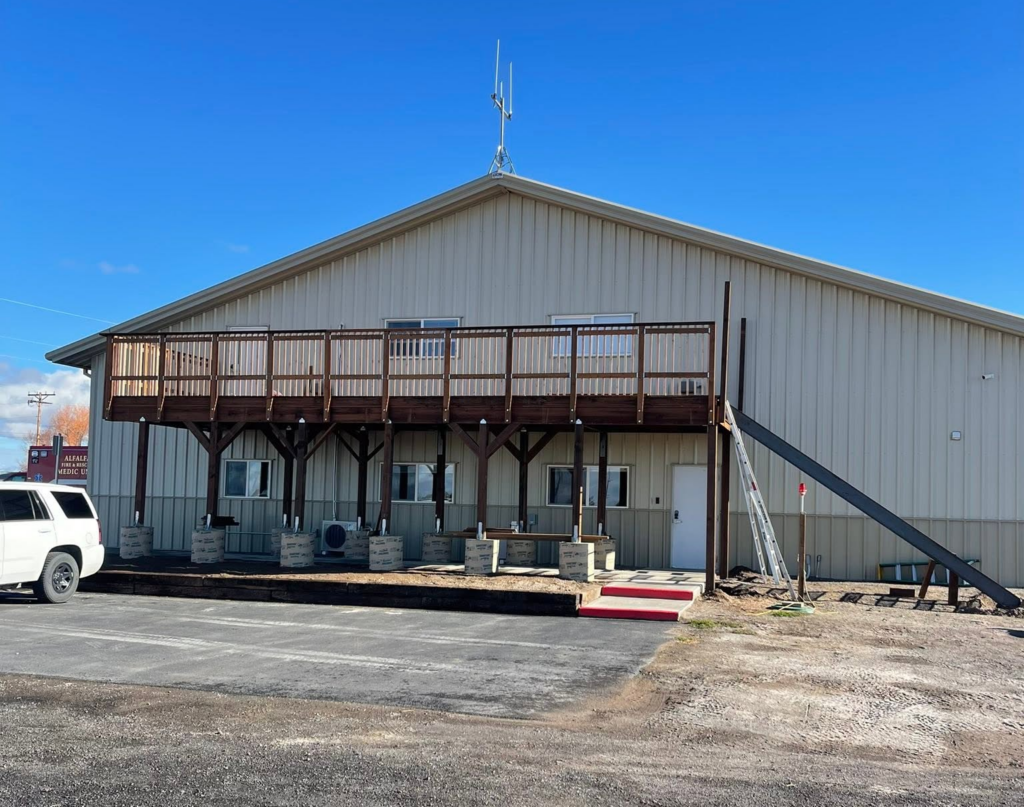
Records show the district applied for a building permit, along with a revision, on Sept. 23rd, 2025. No inspections were ever scheduled or completed, and the application ultimately expired on March 28th, 2026.
Despite the permitting process remaining incomplete, the district reported in a Nov. 20th, 2025 Facebook post that the new “landing” was nearly complete.
The issue takes on additional significance because the district has indicated that the upstairs space was not merely planned for eventual use. During a meeting earlier this year, LaVallee reported that the dormitory space had been completed and was being occupied by two firefighters.
The landing was reportedly among the improvements required as part of the permitting process before the district’s upstairs dormitory space could be approved for use by firefighters, and students with the Central Oregon Community College reportedly engage in regular training using the facilities behind the station.
Recommendation could directly affect Laucks
One of the electors’ most pointed criticisms involved district firefighters simultaneously serving on the Board of Directors.
The group argued that the dual role creates an “inherent conflict of interest” by placing an individual responsible for overseeing the fire chief and establishing district policy simultaneously within the operational chain of command beneath that chief.
“This overlapping authority blurs the lines of accountability, risks creating double standards in training or enforcement, and ultimately damages public trust,” the electors’ statement said.
Their recommendation was direct: “Update district policies to exclude volunteer fire fighters from being board members.”
Laucks is currently the only sitting board member who also serves as a district firefighter.
Former Board Chair Nate Starr previously served in both capacities but reportedly resigned both as a firefighter and from his elected board position, according to legal filings.
Although the electors did not expressly demand that Laucks resign from either role, their recommendation has an obvious practical consequence for the current board chair: if adopted as written, Laucks seemingly could not continue serving in both capacities.
Transparency among central concerns
Government transparency was another major theme of the statement.
The electors criticized the district for failing to make financial records, resolutions and supporting meeting documents readily accessible through its website and raised concerns about how meetings are noticed and agenda subjects are described.
They alleged that different versions of agendas have appeared online and on physical bulletin boards and criticized the district for reducing what they described as a previous seven-day advance-notice practice to approximately 48 hours.
The group also alleged the board has discussed or acted upon matters inadequately described — or omitted altogether — from published agendas.
The electors specifically pointed to the district’s Juniper Acres expansion, arguing that agenda descriptions such as “Discuss Juniper Acres” did not adequately tell residents that annexation or a substantial territorial expansion could be under consideration.
The group ultimately proposed 12 changes, including development of a comprehensive strategic plan; an inventory of district apparatus; a district newsletter and budget calendar; limits on out-of-district responses; restoration of seven-day meeting notice; and publication of materials distributed during public meetings.
More dramatic recommendations included selling the district’s ladder truck, both ambulances and motorized gurney, while establishing strategically located medical kits and firefighting water-storage cisterns throughout the district.
The statement was signed by John Brooks, Ole Olsen, Ian Walker, Dave Henneman, Robin Rudiger, Whitney Griffin, Megin Brooks, Brent Sullivan, Sarah Linden, Gabriele Mimler, Denis Sieben, Roxy Andrade, Ted Rudiger, Val Shewell, Justin Wilks and Frank Spiecker.
New board members inherit district controversies
The lengthy public criticism came on the same night the three remaining directors were tasked with filling two vacancies on the five-member Board of Directors.
Five people had applied for the positions, with four ultimately participating in interviews, including one candidate who joined by telephone while working on a wildfire.
The interviews frequently returned to many of the same problems electors had just spent much of public comment describing.
Asked about her priorities for the coming year, Melanie Holliday placed the district’s outstanding state filings first.
“I want to see those filings for the state taken care of first, and then I think we need to work on some transparency and communications with our community,” Holliday said.
Asked whether she would participate in public meetings training, Holliday said she looked forward to it.
“I want to be in line with what we need to be legal and to be effective,” Holliday said.
Robert Kathman, a former district board president and one of the original founders of the district, was considerably more direct about its condition.
“I think right now there’s a need to try to get the AFD back on track,” Kathman said.
He immediately pointed toward the district’s finances.
“Why do we not have enough money to pay a mortgage for the coming year? Where’d that money go?” Kathman asked. “There’s got to be some questions answered financially.”
Kathman also called for hiring a new chief and “right-sizing” the department’s apparatus based on the actual needs of district residents.
“What do the patrons want from a fire district, as opposed to what does maybe one or two people like the fire chief want?” Kathman said.
Another candidate acknowledged the role increased scrutiny and news coverage have played at the district, saying that while attention from the news media had been “a little bit of a pain in the ass,” he believed “there’s been some good that’s came from it.”
The comment echoed Brooks’ remarks earlier in the meeting that district officials should not blame the news media for bringing problems to the public’s attention.
Following the interviews, the board appointed Holiday to Position 3 on a 2-1 vote over Kathman. Holiday was immediately sworn into office and joined the board for the appointment of its final member. Kathman was subsequently selected for Position 1 and also sworn into office, restoring the district to a five-member board.
Both positions, along with current board member Dustin Piggot’s seat, will be up for election in May of 2027. The election for Piggot and Holiday’s seats will be a special election for the remaining 2 years of those seats’ term. Kathman’s seat will be for a full 4-year term.
Laucks’ chief recruitment plan draws questions
But another discussion immediately following the appointments raised further questions about how decisions are being made while the district remains without a permanent fire chief.
Laucks told the newly constituted board that four candidates had applied for the position. They also mentioned that several applicants had been waiting for months, likely due to the controversy regarding the district’s premature advertisement, which the board also denied knowledge of, while Laucks made conflicting statements revealing he did in fact know about the premature posting.
Local critic Whitney Griffin also questioned the board during a June 30th meeting about earlier statements from LaVallee that claimed he was already interviewing applicants to replace him. That statement was made in early June, well before the board even decided to advertise the position. The board also revealed hundreds of dollars in expenses for the premature online advertising, including postings that originally set a deadline for applications around the time the board formally discussed and decided to move forward.
During the meeting, Laucks then described what he called the “original plan” for interviewing them.
“The original plan was to interview these candidates with myself and one qualified firefighter that is a training director of our fire district,” Laucks said.
Laucks said he wanted to continue the interview process once a training director became available and later said he intended “to push for these interviews as quickly as possible.”
But the district’s own attorney soon clarified that no such interview procedure had actually been established by the board.
“You, as a board, need to create an actual policy or procedure of how you’re going to handle these applicants because you haven’t done that,” Reid told directors.
Laucks subsequently characterized what he had contemplated as an “informal sit down” with applicants, saying information obtained from the candidates would ultimately be presented to the full board.
The proposal drew questions about whether interviews conducted by Laucks and another district official for the purpose of reporting back to the governing body could themselves constitute a committee subject to Oregon’s Public Meetings Law.
This reporter questioned Laucks about his statement that he and a district training director would conduct interviews before bringing the results back to the full board.
“But I believe the concern there, Mr. Laucks, would be you indicated that you and one of the training directors would conduct those interviews and then bring a recommendation,” this reporter said, raising concerns that such an arrangement would constitute a subcommittee subject to Oregon’s public meetings requirements.
Laucks responded that the district had intended to call it an “informal meeting.”
“Whether you call it an informal meeting, sir, it would still be a public meeting because you’re bringing a recommendation to the main board,” this reporter responded.
Reid then agreed with the concern while emphasizing another important distinction: Laucks had described his proposal, not a process actually approved by the Board of Directors.
“He is correct, but the board actually hasn’t decided how the process is going to go,” Reid said. “You suggested that, but … I suggested a more public forum in regards to moving forward.”
During an earlier April 8th board meeting, Laucks and former board member Nathan Starr also disclosed plans for Starr and LaVallee to privately conduct interviews to fill a vacancy on the board, as well as three vacancies on the district’s budget committee. The district later denied that any such interviews were conducted by a subcommittee involving Starr or LaVallee.
The exchange marked another instance during the meeting in which Laucks spoke about district operations in terms of what he intended to do before a distinction was made between his plans as board chair and decisions requiring direction from the Board of Directors as the district’s governing body.
Another member of the public subsequently questioned why a training director needed to participate if the ultimate hiring decision belonged to the board.
Laucks responded that the training director was intended to ask questions specific to fire district operations “because I don’t have the experience in that.”
Rather than proceed under the process Laucks had described, Reid proposed developing a formal interview package and conducting an initial interview process during a public special meeting.
Reid emphasized that the community should also have an opportunity to observe the candidates because the fire chief would serve as the district’s chief administrator.
The board ultimately directed Reid to work with Laucks on developing an interview package and moved toward holding a special meeting for the candidates.
The discussion, coupled with Laucks’ earlier statement that LaVallee apparently continues to hold an official role within the district, leaves several questions unanswered about the district’s current management structure: who has been delegated operational authority while the fire chief position remains vacant, who made those appointments and precisely what authority has been given to those individuals.
During last month’s July 15th meeting, Laucks was repeatedly rebuked by their own attorney after he claimed authority that the board had never delegated.
Those questions come as a significant group of district electors is specifically asking the newly constituted board to exercise greater oversight, improve transparency and adopt clearer organizational and governance practices.
For Holiday and Kathman, those questions are now theirs to answer as well.

Mr. Alderman is an investigative journalist specializing in government transparency, non-profit accountability, consumer protection, and is a subject matter expert on Oregon’s public records and meetings laws. As a former U.S. Army Military Police Officer, he brings a disciplined investigative approach to his reporting that has frequently exposed ethics violations, financial mismanagement, and transparency failures by public officials and agencies.