For months, the Prineville Review has been engaged in ongoing investigative reporting into the Alfalfa Fire District—most recently revealing a state investigation into alleged election law violations tied to the District, as well as documenting repeated and ongoing failures to comply with Oregon’s public meetings laws. The dive into concerns with the rural fire district started in late 2024, when concerned residents reported problems related to an annexation effort that later resulted in the illegal taxing of property owners in Juniper Acres.
That reporting has now been met with escalation.
Editor's Note: You can also review the independent coverage from KTVZ News here about the ongoing issues and the federal court's temporary injunction against the district.
The Prineville Review and KTVZ News then further published a report revealing that the Oregon Secretary of State’s office was investigating the district for possible election law violations.
Three days later, the District issued a formal notice of trespass against this editor. That notice goes further than prior threats, attempting to indefinitely bar a journalist from all District property, including in-person access to public meetings.
The timing is not coincidental.
One of the key issues is on longstanding transparency failures, including significant delays in producing meeting minutes, the continued failure to provide requested minutes from multiple prior meetings—some dating back to 2022—and the most recent delay in releasing minutes from the District’s April 8th meeting. Only after a state complaint seeking an injunction on the public meetings violations was filed did the District release the April 8th minutes. Even now, other requested records for minutes remain outstanding, and we will continue to pursue full compliance to ensure the public is not denied access to the workings of its government.
This did not happen in a vacuum.
Weeks before the trespass was issued, deputies with the Deschutes County Sheriff’s Office were also prepared to actually arrest at the request of the fire district officials, despite no disruption or unlawful conduct following that April 8th public meeting. Following our communications with DCSO, they confirmed that no arrests would be made unless there was an actual disruption to governmental operations or violation of law, and on April 9th, the Sheriff’s Office reportedly declined to effect an arrest when Fire Chief Chad LaVallee again contacted police after we attempted to ask him and his wife questions outside the fire station.

Then, on April 24th, we revealed that the Oregon Secretary of State was investigating the Alfalfa Fire District for possible violations of election law due to prohibited political advocacy through official acts and endorsement with taxpayer resources. Now, the District has escalated further—issuing a formal trespass three days later that goes beyond those initial threats and attempts to permanently exclude a journalist from public meetings altogether.
That escalation matters. It reflects intent.
The District’s justification relied on a newly adopted policy, invoked under the guise of “security,” that was introduced and enforced the same day. In practice, it has been used to shut down routine newsgathering—specifically, speaking with members of the public after meetings—and now to justify excluding a reporter entirely from District property.
And after yesterday’s meetings, it is clear its enforcement has been selective at best.
There was no disruption. No interference. No lawful basis for removal.
What remains is a clear constitutional issue.
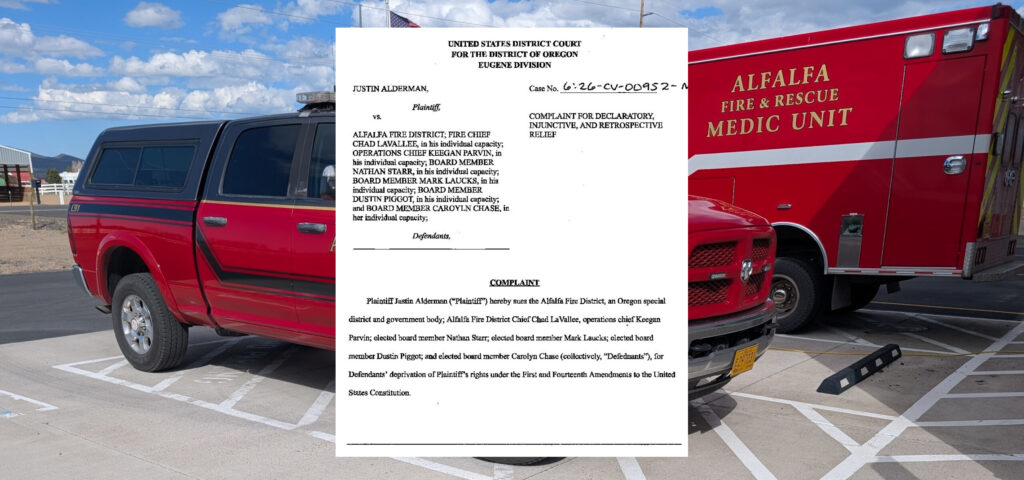
Earlier this week, we filed a federal lawsuit and motion for a temporary injunction against the Alfalfa Fire District and related officials in the United States District Court for the District of Oregon, asserting violations of this editor’s First and Fourteenth Amendments and seeking emergency injunctive relief. Shortly before the District’s meeting yesterday evening, a federal judge issued a Temporary Restraining Order and set further proceedings on our request for a preliminary injunction.
Despite that federal court order, District Board President Nathan Starr and board member Mark Laucks still attempted to enforce the trespass against this editor during or after the meeting. Even after being served with the federal judge’s order, they also tried to involve the Deschutes County Sheriff’s Office.
According to DCSO Public Information Officer Jason Carr, the Sheriff’s Office declined to respond and has repeatedly informed District officials that it would not be attempting to enforce the District’s desired trespass order—even separate and apart from the federal court’s Temporary Restraining Order, and had no intent to effect arrests on any citizens who are not actually violating the law or disrupting governmental operations.
More troubling still, Nathan Starr repeatedly stated during the public meeting, including in response to questions by KTVZ News, that he refused to read the federal court’s order that had been served per the court’s instruction, and at one point reportedly told attendees that the order came from a “fake judge.” Those statements were made despite the order having been formally issued by the United States District Court and served on the District shortly before the meeting.
Beyond the District’s conduct toward the Prineville Review, hostility toward other members of the news media was also on full display during the meeting. The conduct and atmosphere directed at journalists extended beyond a single newsroom and further underscored the growing concerns surrounding transparency, accountability, and treatment of the media by District leadership and supporters. Reporting from KTVZ News provides a fuller context regarding that conduct and the events surrounding the most recent meeting.
This action is a direct violation of the First and Fourteenth Amendments to the United States Constitution, as well as protections guaranteed under Article I, Section 8 of the Oregon Constitution. It represents both a form of prior restraint and a misuse of government authority to restrict protected speech and newsgathering. Public meetings are not optional forums controlled at the discretion of officials—they are fundamental mechanisms of public oversight. A government body cannot selectively exclude a journalist, particularly in response to critical reporting.
And that is what this is.
The trespass is not an isolated decision, but part of an ongoing pattern. The fire chief has repeatedly objected to our reporting, resisted public records requests, and tied threats directly to our continued investigation. Those threats escalated to the point of Fire Chief Chad LaVallee publicly posting false and defamatory claims of “illegal dealings”, and that they had hired a private investigator to look into alleged illegal conduct related to our newsgathering—claims that are entirely false. These actions were made in the clear context of attempting to deter and intimidate continued reporting.
What business does a local fire district have hiring private investigators to dig into private citizens and journalists, except to clearly engage in an act of intimidation?
This latest action—formalizing exclusion through threats of criminal trespass—is the most aggressive step yet in what has become a sustained effort to intimidate, harass, and silence independent journalism.
We reject it outright.
Public agencies do not get to decide who covers them. They do not get to use law enforcement as an intermediary to chill speech. And they do not get to rewrite the Constitution under the cover of internal policy.
This issue has already drawn attention from organizations dedicated to protecting press freedom, and we are grateful for the support forming for this legal fight and engagement from those who understand the stakes.
Because the stakes are not limited to one newsroom.
If a public body can permanently bar a journalist (or any citizen) from public meetings, then the public’s right to observe its government is meaningless. The precedent such an action would set is dangerous—not just here in Central Oregon, but across the state.
We also want to be clear: we encourage members of the public to speak. Those with concerns about their local government should share their perspectives. Those who support the District and its leadership should do the same. Public discourse depends on participation from all sides. For those who have withheld speaking out due to fear of retaliation or prior experiences, including conduct they believe was intended to silence them, we encourage you to come forward. You can speak with us, or with our colleagues in local news media.
And on a personal note, investigative reporting into local government—including a rural fire protection district—should not be mischaracterized as hostility toward firefighters, public servants, or the community. That framing has been suggested in response to our work on the Alfalfa Fire District, and it is both inaccurate and misleading. As a U.S. Army veteran and as someone with a family history rooted in military service and civilian first responder roles in policing and firefighting in the Pacific Northwest, I have deep respect for those who serve. That respect, however, cannot be used as a shield to deflect legitimate questions or to discredit those seeking transparency. Gratitude for public service does not require silence, and it cannot be weaponized to suppress accountability or differing views.
We will continue reporting. We will continue asking questions. And we will not be deterred.
To Our Readers
As we prepare for this legal fight and continue our commitment to providing important local news and investigative reporting, we ask for your support. Independent journalism—especially at the local level—depends on the trust and backing of the community it serves. If you value transparency, accountability, and the ability to ask questions of those in power, we encourage you to stand with us, share our reporting, and help ensure that this work continues. You can also consider a donation by clicking here

Mr. Alderman is an investigative journalist specializing in government transparency, non-profit accountability, consumer protection, and is a subject matter expert on Oregon’s public records and meetings laws. As a former U.S. Army Military Police Officer, he brings a disciplined investigative approach to his reporting that has frequently exposed ethics violations, financial mismanagement, and transparency failures by public officials and agencies.