When Gov. Tina Kotek convened the first meeting of her newly named Prosperity Council on Jan. 22, she told the 16-member panel what she hoped to achieve.
“The goals I’ve put forward—about growing our GDP, creating new jobs and supporting the workforce we need for the future—those are very simple goals,” Kotek said. “And they are very urgent goals.”
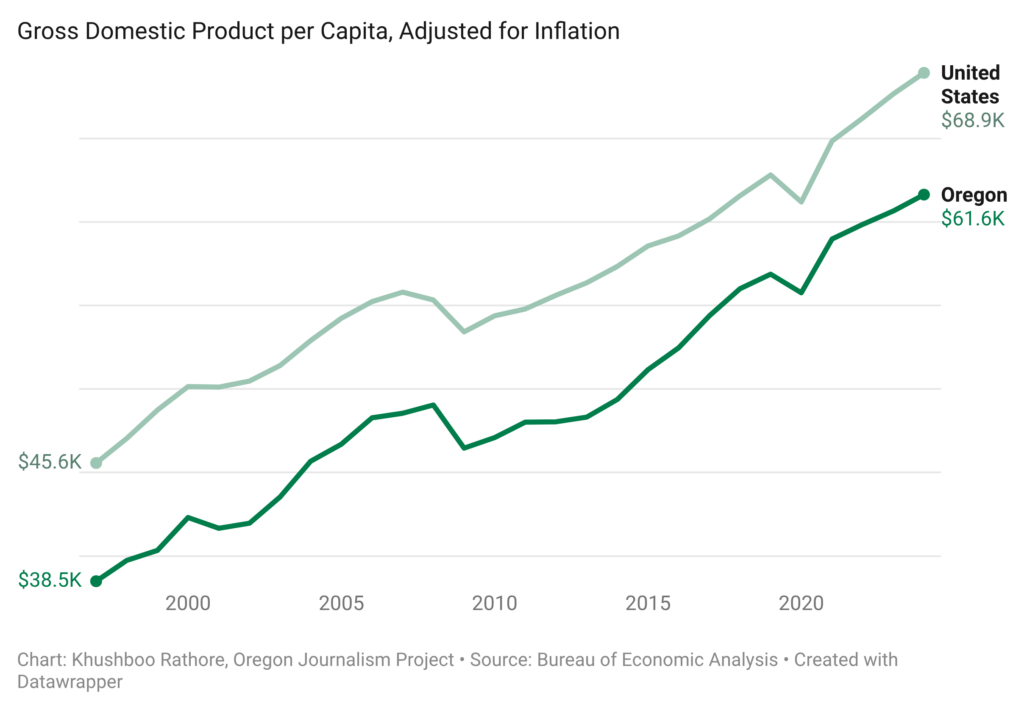
In terms of gross domestic product per capita, Oregon has lagged behind the national average for decades.
That metric measures everything a state produces—in Oregon’s case, everything from computer chips to hazelnuts—divided by its population.
Oregon’s current output per capita is $61,600, compared with the nation’s $68,900. In terms of productivity, Oregon has narrowed the gap only 5 percentage points since 1997.
For decades, Oregon’s growing population supported its economic outcomes. With population stagnating, however, the state needs to shift focus to “productivity and investment,” says former state economist Mark McMullen, now a vice president at Common Sense Institute Oregon.
Kotek hopes her Prosperity Council, led by Ampere Computing founder Renée James and Port of Portland executive director Curtis Robinhold, will come up with suggestions for how to make that happen.
Oregon Business & Industry CEO Angela Wilhelms says Oregon has made it harder for existing businesses to succeed. She’d like the council to cut through the red tape.
Oregon is the seventh-most-regulated state for businesses in the country, according to a report by OBI. High regulations and taxes have had many companies move out of the state after becoming licensed, according to a story by the Oregon Capital Chronicle.
Many Oregon business leaders think the state government doesn’t listen to them or isn’t “interested in their success,” Wilhelms says.
“Leaders have not really taken a good, holistic look at what [regulations are] doing to us as a state, economically or competitively,” she adds.
Other states have used tax breaks and credits to woo new businesses and increase GDP.
Trying to get businesses in other states to move their operations to Oregon may be a lost cause, McMullen says.
“Oregon can’t offer the cheap labor that a lot of these other states can. Our wages are higher.”
The state needs to focus on supporting its “homegrown industries,” McMullen says. After Phil Knight co-founded Nike in Oregon, its success brought in other companies and services, he says.
Correction: A previous version of this story relied on an inaccurate analysis of Oregon’s and the nation’s gross domestic product per capita. As a result, the story mistakenly reported that the gap between Oregon’s GDP per capita and the nation’s had widened significantly since 1997, but in fact it has gone down slightly. The story has been corrected to eliminate the errors.
***
This story was produced by the Oregon Journalism Project, a nonprofit investigative newsroom for the state of Oregon. The Prineville Review became a partner of OJP in August of 2025 in order to bring our readers investigative reporting from across Oregon.

Khushboo Rathore
Khushboo Rathore is a data and engagement reporter for the Oregon Journalism Project. She has journalism and information science degrees from the University of Maryland, College Park. She was most recently the Roy W. Howard Fellow at Wisconsin Watch.