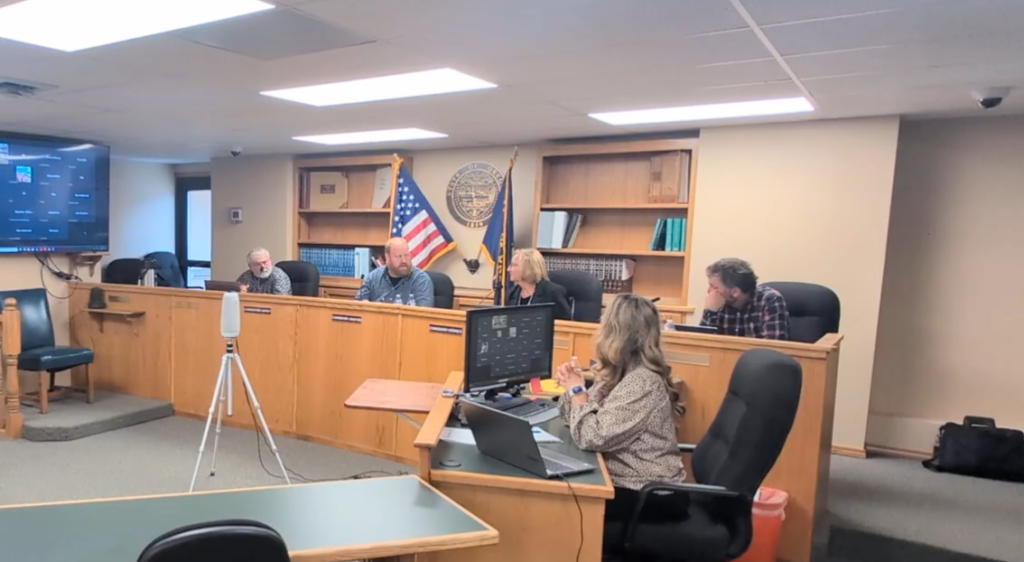
Prineville, Ore. — A Crook County hearings officer will decide Wednesday whether evidence involving Knife River’s aggregate operation northwest of Prineville is sufficient to begin formal proceedings that could modify or revoke the company’s conditional-use permits.
The public hearing is scheduled for 4 p.m. July 29th at the Crook County Meeting Room, 320 NE Court Street in Prineville. The county will also offer remote participation through Zoom.
The proceeding concerns Knife River’s Woodward mining operation at 4755 NW Stahancyk Lane and a permit covering the adjoining Vanier property at 6487 NW Lamonta Road.
A staff report issued July 22nd makes clear that Hearings Officer Joshua Soper will not decide Wednesday whether either permit should actually be revoked or modified. Instead, the question is whether the record establishes “reasonable suspicion” — described as “any reason to believe” under the totality of the circumstances — that a full proceeding should be initiated.
That leaves Soper with three possible paths identified by county staff: initiate a revocation proceeding, initiate a modification proceeding to consider targeted operational remedies, or decline to initiate any further proceeding.
The county staff report does not expressly recommend one of those outcomes. Instead, it separates the allegations and evidence, identifies the applicable standards and asks Soper to determine which issues, if any, clear the preliminary threshold.
Two mining approvals are connected
Knife River received the Woodward conditional-use permit in 2015. The site includes approximately 76 acres zoned Exclusive Farm Use and 36 acres zoned Heavy Industrial.
The permit allows sand and gravel extraction and water storage on the farm-zoned parcel, identified as tax lot 703, while processing is limited to the industrially zoned tax lot 702. The county imposed 31 conditions covering matters including operating hours, traffic, groundwater protections, reclamation, screening berms, dust and mosquito control.

A 2018 modification increased the number of permitted truck trips, an issue county staff says is not part of the current dispute.
In 2022, the Crook County Court approved a separate conditional-use permit for Knife River’s proposed expansion onto the adjoining 78-acre Vanier property. Operations have not started there because Knife River and Crook County have not executed a required groundwater-protection guarantee.
The Vanier permit incorporates the conditions of the Woodward approval and requires material from the expansion site to be processed through the Woodward operation. County staff therefore concluded that modifying or revoking Knife River’s rights at Woodward would also affect its ability to operate on the Vanier property.
Complaints increased in recent years
According to the staff report, Knife River operated from 2015 until at least 2022 without the county receiving formal complaints from neighboring landowners. In recent years, however, the county has received numerous complaints involving “almost all aspects” of the company’s operation.
Many of those complaints were handled through the county’s ordinary code-compliance process, which emphasizes correcting violations voluntarily rather than immediately imposing penalties or pursuing formal enforcement.
County staff said the record shows many instances in which Knife River appeared to operate inconsistently with its approval or caused disruption for neighboring property owners. At the same time, the report characterized the company as “responsive” once code-compliance investigations began and said the issues were typically resolved quickly.
Staff said that pattern could be viewed as evidence that the county’s voluntary-compliance system is working. It also raised a broader concern that the code does not squarely address a permit holder repeatedly coming into compliance following separate allegations.
“[T]he code provision does not envision or address a permittee coming into compliance again and again for repeated, discrete allegations of violations,” the report states.
LandWatch and neighbors seek further proceedings
The matter began after Robin Hayakawa of Central Oregon LandWatch and neighboring residents asked the Crook County Planning Commission in March to consider modifying or revoking Knife River’s permits.
Planning Director John Eisler recommended referring the initial decision to an independent hearings officer. Eisler said the preliminary decision could itself be an appealable land-use decision and raised concerns about possible bias because of the politically charged nature of the dispute.
The Board of Commissioners later appointed Soper, a land-use attorney with Beery, Elsner & Hammond LLP, and directed him to decide whether sufficient evidence exists to initiate a formal proceeding.
Adam and Karen Mikulski submitted dozens of complaints, photographs, agency records and other materials. Their filing alleges violations involving groundwater-monitoring requirements, settling ponds, setbacks, the use of imported material to backfill mined areas and failures to reclaim land as mining progressed.
LandWatch submitted a separate filing arguing that the record shows a pattern of documented permit violations, violations not contested by Knife River, independent state-agency findings and unresolved groundwater concerns.
Among the allegations are vehicles operating outside permitted hours, use of an unauthorized private road, failures involving baseline well reports, inadequate screening vegetation, improper filling of mining ponds, missing weed-control reports and a failure to develop a mosquito-control plan.
“This list is far from comprehensive,” LandWatch wrote. “Indeed, the amount of evidence of violations of the terms and conditions of the CUP is too voluminous to include at this early stage.”
LandWatch emphasizes that the present proceeding does not require the hearing officer to accept all allegations as true or find that revocation is justified. It argues that the complaints, enforcement actions and agency findings at least provide a reason to open a more complete review.
Knife River acknowledges two recent county violations
Knife River acknowledges two recent county enforcement matters.
The first involved pumping equipment used to fill settling ponds outside approved operating hours on three dates in November 2025. The second, issued in May 2026, involved missing or inadequate barriers at access points to the mine site. Knife River did not contest the violations and paid the fines.
Knife River attorney Mark Bartholomew said the company corrected both matters and has not repeated them.
The company argues that a county-code provision written specifically for aggregate sites controls any possible revocation. Under that provision, a permit may be revoked if the operator submitted false or misleading material information or intentionally violated mining laws in a manner causing substantial injury.
Knife River says the two recent violations were unintentional, promptly corrected and caused no demonstrated injury.
“Revocation for two violations is disproportionate to the violations, highly punitive, and unconstitutional,” Bartholomew wrote in a July 15th letter to the County.
Knife River also argues that unproven complaints from residents cannot be treated as established code violations and that revoking its permit would amount to a constitutionally excessive forfeiture.
The staff report concludes those constitutional arguments concern the possible outcome of a future revocation proceeding and are outside the limited scope of Wednesday’s threshold hearing.
State agencies report current compliance
County staff’s review gives a more limited picture of Knife River’s recent compliance with permits administered by the Oregon Department of Environmental Quality and the Oregon Department of Geology and Mineral Industries.
DOGAMI told the county that, apart from concerns it previously identified involving settling ponds and reclamation, Knife River is currently in compliance with its DOGAMI operating permit and its groundwater investigation plan.
DEQ also reported that it is not aware of any current violations or unresolved enforcement actions involving Knife River’s air-quality permit. Two violations noted during a September 2024 inspection — failure to submit notice for a second rock crusher and failure to report local air-quality complaints — were resolved.
DOGAMI and DEQ similarly reported that Knife River is currently compliant with its water-pollution-control permit and that they are unaware of additional violations under that permit beyond a previously adjudicated discharge case.
2020 discharge resulted in $20,822 penalty
The earlier water case stemmed from discharges in 2020 involving washwater, stormwater and excavation-dewatering water from the Woodward site into the Rye Grass Irrigation Canal.
DEQ imposed a civil penalty of $20,822 in 2022. According to the staff report, Knife River said it discovered that water had been pumped into the canal when its settling ponds neared overflowing and reported that no further off-site dewatering or discharges occurred.
DEQ classified Knife River’s mental state as “reckless,” rather than intentional.
County staff said that distinction is important because the aggregate-specific revocation standard requires intentionally unlawful mining operations resulting in substantial injury.
Staff concluded that the 2020 discharge does not appear to support revocation under that provision because it was not deemed intentional and has not been repeated. The report described it as a closer question under the county’s general permit provision, which allows action when a permit “is being or recently has been exercised” contrary to its conditions.
The report leaves Soper to determine whether conduct from 2020 can reasonably be considered “recent.”
Settling ponds and reclamation emerge as key concerns
The strongest basis identified by staff for possible further action appears to involve settling ponds and reclamation on the farm-zoned portion of the Woodward property.
Knife River’s permit limits activities on tax lot 703 to sand and gravel extraction and water storage and expressly prohibits processing on that parcel.
In October 2025, DOGAMI told Eisler that the settling ponds are “an integral part of the facility processing operations.” DOGAMI concluded that using the ponds on tax lot 703 to settle process water was inconsistent with both the state operating permit and Crook County’s land-use approval.
DOGAMI also identified two areas that it said had not been reclaimed to agriculture as required: the area containing the process-water ponds and a mined area being used for stockpiling.
“The fact that the other two areas … have not been concurrently reclaimed to agriculture per the Woodward CUP condition 22 is inconsistent with both the CUP and the DOGAMI operating and reclamation plan,” the agency wrote.
DOGAMI said no portion of its permit prevents Crook County from independently enforcing county land-use conditions.
DOGAMI told county staff this month that it was not aware of any change in the status of those areas since its October findings.
Groundwater source has not been determined
LandWatch and neighboring property owners have raised extensive concerns about arsenic, aluminum, manganese and other contaminants detected in domestic wells near the mine.
Knife River is conducting a groundwater investigation required by DOGAMI, and DEQ has completed two rounds of domestic-well sampling.
The new staff report, however, says testing has not identified the source of the contamination or attributed it to Knife River.
“To date, none of this testing has identified causation or attributed the contamination to Permittee’s operations,” the report states.
That finding narrows how groundwater contamination may be considered at this stage. County staff previously advised that contamination alone could not support revocation unless state regulators determined Knife River was responsible.
The staff report nevertheless points to representations made on Knife River’s behalf during the 2015 permitting process. Those statements asserted there was no risk to an aquifer from the processing area and that a shallow aquifer on the eastern portion of the property did not appear to extend to the proposed ponds.
County staff now says studies have confirmed that the shallow aquifer extends to the settling-pond area.
Soper must determine whether that new information and the operational concerns create reasonable suspicion sufficient to consider modification under the county code, including provisions addressing wrong or misleading information and operation contrary to permit conditions.
Staff identifies possible targeted changes
Rather than revocation, the staff report specifically raises the possibility of modifying the permit to address concerns while limiting disruption to Knife River.
Staff notes that revocation is a severe remedy, while modification could be used to impose narrower operational changes. It asks whether the same threshold should apply to both remedies and whether evidence might justify considering modification even if it does not justify considering revocation.
Among the possible remedies identified by staff are requiring Knife River to fully reclaim the EFU-zoned tax lot for agriculture, relocating the settling ponds to the heavy-industrial parcel and requiring the ponds to be lined.
Staff said such modifications could address public-health and safety concerns involving groundwater and fugitive dust.
Those are examples rather than recommendations or proposed final permit conditions. Any modification would require a separate proceeding with additional evidence and an opportunity for the parties to be heard.
Written testimony will continue to be accepted until the record closes, which could occur at the conclusion of Wednesday’s hearing. The county advises that an issue generally must be raised with sufficient specificity during the local proceeding to preserve it for a possible appeal to the Oregon Land Use Board of Appeals.

Mr. Alderman is an investigative journalist specializing in government transparency, non-profit accountability, consumer protection, and is a subject matter expert on Oregon’s public records and meetings laws. As a former U.S. Army Military Police Officer, he brings a disciplined investigative approach to his reporting that has frequently exposed ethics violations, financial mismanagement, and transparency failures by public officials and agencies.