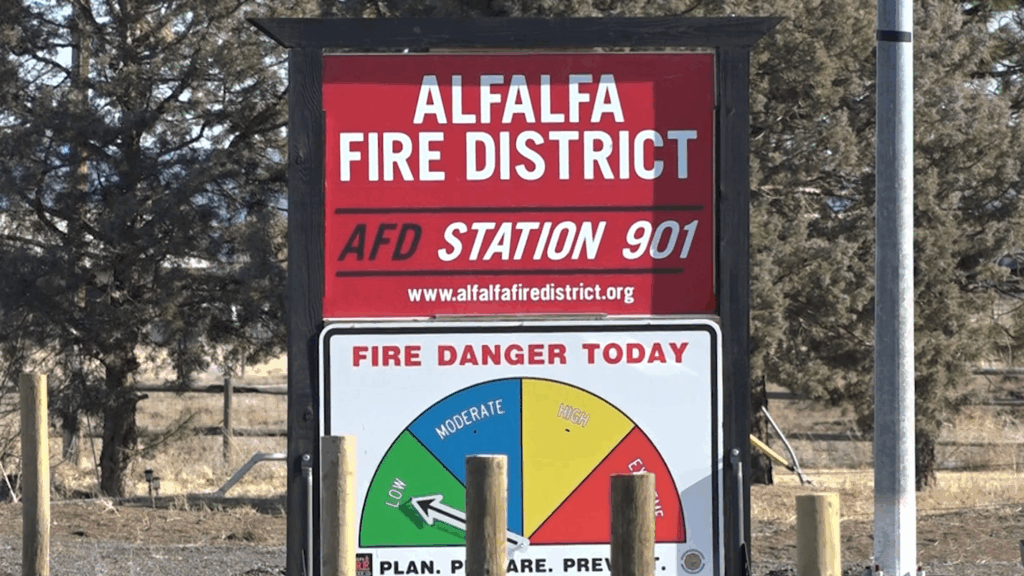
Alfalfa, Ore. — Election night results suggest voters overwhelmingly rejected the levy while supporting fire funding requests elsewhere across Central Oregon, a result that could deepen questions surrounding one of the region’s most controversial fire districts.
Preliminary returns showed Measure 9-184, Alfalfa Fire District’s proposed five-year local option levy, trailing heavily with 77.07% opposed and 22.93% in favor. The levy sought to double property taxes by $1.75 per $1,000 of assessed value, on top of an existing $1.75 per, for a total of $3.50 per $1,000.
The proposed levy would have effectively doubled taxes within the district and, according to district materials and prior reporting, was intended to maintain staffing levels that had only recently become possible through grant funding pursued under Chief Chad LaVallee’s administration.
District officials argued the measure was necessary to preserve staffing and maintain operational capacity. But the levy campaign unfolded under circumstances far different from most local fire funding measures due to opponents crying foul about alleged election law violation’s by district officials.
Public opposition also appeared increasingly visible in the days immediately preceding the election.
During the district’s May 13th meeting, residents publicly raised concerns over affordability and the financial impact of the proposed levy. Public comments appeared overwhelmingly opposed to the measure, with residents questioning both the tax burden and the district’s justification for seeking additional funding.
Numerous attendees voiced their concerns with the levy, including local resident Joanne McBridge who says she lives now off social security.
“…which at that time you asked for $1.75 per thousand for the building to be put up and everything. Okay, that made my taxes go up $800. Now you’re asking again for another $1.75. That makes my taxes go up $2,000. I live on Social Security. No one takes care of me. I take care of myself. This is absolutely unrealistic,” said McBride.

Others expressed their concerns supporting the effort amid the district’s ongoing transparency issues and questions about Fire Chief LaVallee’s alleged misuse of office and of district funds and resources.
The meeting offered one of the clearest public snapshots before election day that voter frustration may have extended beyond district controversies and into broader concerns surrounding affordability and confidence in district leadership.
The election came amid months of controversy surrounding LaVallee and district leadership, including multiple investigations, ethics complaints, legal disputes, and broader questions regarding district governance.
Reporting by the Prineville Review and partners at KTVZ previously confirmed the Oregon Secretary of State has an ongoing investigation into alleged election-law violations involving LaVallee and district officials. The investigation followed questions involving district communications and alleged advocacy-related conduct surrounding the levy campaign and use of public resources.
More recently, the Oregon Government Ethics Commission voted to initiate a full investigation into multiple alleged violations of Oregon ethics law by Chief LaVallee.
Other reporting since late last year also examined disputes involving public meetings, records transparency, and broader leadership concerns.
Investigative reporting by the Prineville Review previously found one of the district’s recent staffing positions had primarily been funded through a state capacity staffing grant and was largely occupied by LaVallee’s wife until her resignation in January. That grant funding was scheduled to continue supporting the position through June of this year. Those issues are also among those being looked into by the OGEC.
Separate reporting also examined records indicating LaVallee and his wife received overtime compensation through a wildfire staffing grant program. More recently, officials disclosed the district was denied a 2026 wildfire staffing grant after the Oregon State Fire Marshal cited multiple ongoing state investigations as part of its explanation.
The district argued the local option levy would provide long-term financial stability as grant funding expired. But election night returns suggest voters may have distinguished support for fire protection services from broader concerns involving district leadership. Opponents we talked to continued to signal their support for their volunteers and front-line firefighters, focusing more on questions surrounding the district’s leadership.
Despite the apparent defeat of the levy, the broader controversy surrounding the district is unlikely to end with election night. Prior Oregon election-law enforcement actions suggest such investigations typically proceed regardless of whether a ballot measure passes or fails. Such reviews generally focus on the underlying conduct itself — including questions surrounding advocacy, use of public resources and official actions — rather than the outcome at the ballot box.
Other fire districts see strong voter support
Elsewhere in Central Oregon, voters appeared strongly supportive of local fire funding requests.
Measure 9-182, the levy proposal for the Sisters-Camp Sherman Rural Fire Protection District, showed overwhelming support on election night, with preliminary returns indicating 76.60% voting in favor and 23.40% opposed.
Meanwhile, Measure 9-183, the levy proposal for the Cloverdale Fire District, also appeared on track for passage, though by a narrower margin. Election night returns showed approximately 60% in support and 40% in opposition.
As with all election night reporting, results remain unofficial pending canvassing and the counting of additional ballots.
We will bring you the latest and update this reporting with further reaction and any critical updates to reported returns.

Mr. Alderman is an investigative journalist specializing in government transparency, non-profit accountability, consumer protection, and is a subject matter expert on Oregon’s public records and meetings laws. As a former U.S. Army Military Police Officer, he brings a disciplined investigative approach to his reporting that has frequently exposed ethics violations, financial mismanagement, and transparency failures by public officials and agencies.