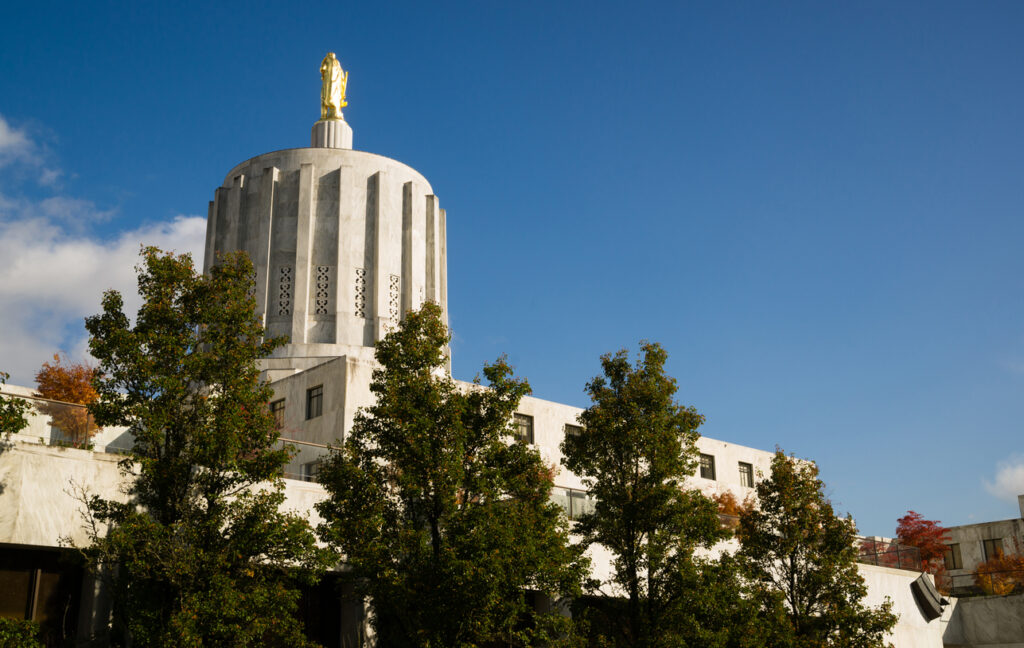
Salem, Ore. – Oregon Governor Tina Kotek on Friday issued a formal notice that she is considering vetoing a controversial public meetings bill, citing concerns that portions of the legislation could weaken government transparency.
The notice, issued under Article V, Section 15b(4) of the Oregon Constitution, identifies House Bill 4177, a measure dealing with Oregon’s public meetings law, as under review for a potential veto.
In a brief statement, the governor’s office said Kotek “understands the intent of the legislation,” but is weighing whether parts of the bill “may undermine transparency in the conducting of public business.”
Kotek has until April 17th to make a final decision.
Despite the governor’s concerns, House Bill 4177 advanced through the Legislature with broad bipartisan support, reflecting backing from both Democratic and Republican lawmakers.
The bill was also driven in part by concerns raised by local governments. The League of Oregon Cities had previously pushed for changes to Oregon’s public meetings law, particularly around how it applies to communications outside formal meetings. Officials, through the organization, argued that existing interpretations of the law — especially regarding serial communications — created confusion and posed challenges for elected officials trying to conduct routine government business.
Those concerns are directly reflected in House Bill 4177, which seeks to clarify how public officials can communicate outside of public meetings while still complying with transparency requirements. Supporters in the Legislature framed the measure as a modernization effort intended to resolve that confusion and provide clearer guidance to public bodies.
Concerns about the bill have also come from within state government itself — including from Susan Myers, Executive Director of the Oregon Government Ethics Commission, who was appointed through a process involving the governor.

In written testimony to lawmakers, Myers warned that a key provision in the bill would allow officials to conduct significant portions of government business outside public view. She pointed to language creating an exception for communications “for the purpose of gathering information,” cautioning that it could allow governing body members to meet privately without notice, records, or public observation.
As an example, Myers noted that under the proposal, officials could conduct activities such as candidate interviews for a public position entirely in private — bypassing traditional executive session requirements and eliminating public oversight. In public commentary, Myers was even more direct, saying parts of the bill gave her “heartburn,” reflecting concern about the scope of the proposed changes.
Earlier today, during the OGEC’s regular monthly meeting, in which the Prineville Review attended, Myers signaled to commissioners that the agency was preparing for the changes in the law, should it be signed by the governor.
The governor’s announcement comes amid mounting opposition from newspapers and journalism organizations across Oregon, many of which have urged her to reject the bill outright.
Editorial boards have warned that the legislation, while framed as a modernization effort, could create new barriers to public access and reduce accountability in how government decisions are made.
A commentary published by The Bulletin warned the bill could create “huge loopholes” in Oregon’s open meetings law and allow more public business to be conducted “in a shroud of secrecy.” Similarly, The Oregonian Editorial Board has called on Kotek to veto the measure, warning it risks rolling back key transparency safeguards.
House Bill 4177 has drawn scrutiny from numerous other news media organizations and transparency advocates who say certain provisions could:
- Expand allowances for less accessible or private communications
- Reduce clarity around notice requirements
- Allow deliberative steps to occur outside public view
Supporters, meanwhile, maintain the bill is intended to address real-world operational challenges faced by local governments.
Kotek’s notice does not guarantee a veto, but signals serious concern at the highest level of state government.
This publication also strongly opposes House Bill 4177 in its current form, though it acknowledges some positive changes included in the proposal. Among them is the extension of the deadline to file public meetings grievances from 30 to 90 days — a change that could allow additional time for informal conferral with public officials before members of the public and journalists who struggle with government compliance, initiating the grievance process.
That process affords the public body 21 days to formally respond to the grievance. However, grievances remain only a preliminary step, intended to provide public bodies and officials an opportunity to address alleged violations before the matter is escalated to a formal complaint and investigation by the Oregon Government Ethics Commission.
This is a developing story, and we will keep you updated on it.
Mr. Alderman is an investigative journalist specializing in government transparency, non-profit accountability, consumer protection, and is a subject matter expert on Oregon’s public records and meetings laws. As a former U.S. Army Military Police Officer, he brings a disciplined investigative approach to his reporting that has frequently exposed ethics violations, financial mismanagement, and transparency failures by public officials and agencies.